
|
You entered: nearby
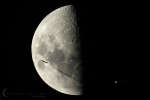 Fly Me to the Moons
25.02.2013
Sometimes the Moon is a busy direction. Last week, for example, our very Moon passed in front of the planet Jupiter. While capturing this unusual spectacle from New South Wales, Australia, a quick-thinking astrophotographer...
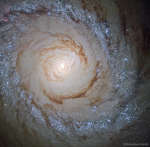 Starburst Galaxy M94 from Hubble
1.12.2019
Why does this galaxy have a ring of bright blue stars? Beautiful island universe Messier 94 lies a mere 15 million light-years distant in the northern constellation of the Hunting Dogs (Canes Venatici).
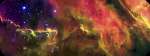 The Southern Cliff in the Lagoon
15.05.2021
Undulating bright ridges and dusty clouds cross this close-up of the nearby star forming region M8, also known as the Lagoon Nebula. A sharp, false-color composite of narrow band visible and broad band near-infrared...
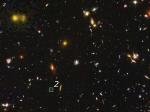 Building Galaxies in the Early Universe
10.09.2007
What was the very early universe like? To help find out, astronomers pointed the Hubble Space Telescope between bright nearby objects to create one of the deepest images ever -- the Hubble Ultra Deep Field (HUDF). The resulting HUDF is like a jewel box of strange and distant galaxies.
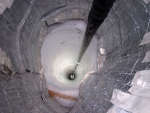 Ice Fishing for Cosmic Neutrinos
13.02.2011
Scientists are melting holes in the bottom of the world. In fact, almost 100 holes melted near the South Pole are now being used as astronomical observatories. Astronomers with the IceCube Neutrino Observatory lowered into each vertical lake a long string knotted with basketball-sized light detectors. The water in each hole soon refreezes.
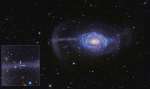 NGC 4651: The Umbrella Galaxy
2.07.2014
Spiral galaxy NGC 4651 is a mere 62 million light-years distant, toward the well-groomed northern constellation Coma Berenices. About the size of our Milky Way, this island universe is seen to have a faint umbrella-shaped structure that seems to extend (left) some 100 thousand light-years beyond the bright galactic disk.
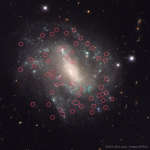 The Supernova and Cepheids of Spiral Galaxy UGC 9391
6.06.2016
What can this galaxy tell us about the expansion rate of the universe? Perhaps a lot because UGC 9391, featured, not only contains Cepheid variable stars (red circles) but also a recent Type Ia supernova (blue X).
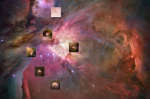 Planetary Systems Now Forming in Orion
22.12.2009
How do planets form? To help find out, the Hubble Space Telescope was tasked to take a detailed look at one of the more interesting of all astronomical nebulae, the Great Nebula in Orion.
 The W in Cassiopeia
18.03.2016
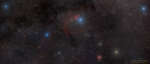
A familiar, zigzag, W pattern in northern constellation Cassiopeia is traced by five bright stars in this colorful and broad mosaic. Stretching about 15 degrees across rich starfields, the celestial scene includes dark clouds, bright nebulae, and star clusters along the Milky Way. In yellow-orange hues Cassiopeia's alpha star Shedar is a standout though.
 The Tarantula Nebula
16.11.2017
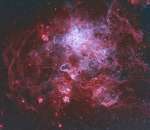
The Tarantula Nebula is more than a thousand light-years in diameter, a giant star forming region within nearby satellite galaxy the Large Magellanic Cloud, about 180 thousand light-years away. The largest, most violent star...
|
January February March April May June July August September |
|||||||||||||||||||||||||||||||||||||||||||||||||