
|
You entered: dust cloud
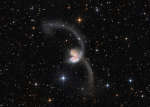 Exploring the Antennae
31.03.2022
Some 60 million light-years away in the southerly constellation Corvus, two large galaxies are colliding. Stars in the two galaxies, cataloged as NGC 4038 and NGC 4039, very rarely collide in the course of the ponderous cataclysm that lasts for hundreds of millions of years.
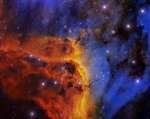 IC 5067 in the Pelican Nebula
26.05.2016
The prominent ridge of emission featured in this sharp, colorful skyscape is cataloged as IC 5067. Part of a larger emission nebula with a distinctive shape, popularly called The Pelican Nebula, the ridge spans about 10 light-years following the curve of the cosmic pelican's head and neck.
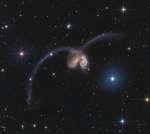 Exploring the Antennae
28.04.2017
Some 60 million light-years away in the southerly constellation Corvus, two large galaxies are colliding. Stars in the two galaxies, cataloged as NGC 4038 and NGC 4039, very rarely collide in the course of the ponderous cataclysm that lasts for hundreds of millions of years.
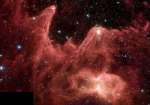 Mountains of Creation
15.12.2007
(xxxedit and linkxxx) This fantastic skyscape lies at the eastern edge of giant stellar nursery W5, about 7,000 light-years away in the constellation Cassiopeia. An infrared view from the Spitzer Space Telescope...
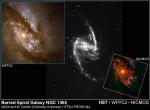 NGC 1365: Barred Spiral Galaxy
8.10.1999
NGC 1365 is a giant barred spiral galaxy about 200,000 light-years in diameter and 60 million light-years distant in the southern constellation Fornax. These three recently released images offer views of this majestic island universe in visible and infrared light.
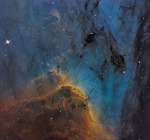 Pelican Nebula Close Up
26.11.2011
The prominent ridge of emission featured in this vivid skyscape is designated IC 5067. Part of a larger emission nebula with a distinctive shape, popularly called The Pelican Nebula, the ridge spans about 10 light-years and follows the curve of the cosmic pelican's head and neck.
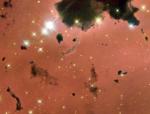 Thackerays Globules
16.08.2003
Rich star fields and glowing hydrogen gas silhouette dense, opaque clouds of interstellar gas and dust in this Hubble Space Telescope close-up of IC 2944, a bright star forming region in Centaurus, 5,900 light-years away. The largest of these dark globules, first spotted by South African astronomer A. D.
 Yellow Balls in W33
30.01.2015
Infrared wavelengths of 3.6, 8.0, and 24.0 microns observed by the Spitzer Space Telescope are mapped into visible colors red, green, and blue in this striking image. The cosmic cloud of gas and dust is W33, a massive starforming complex some 13,000 light-years distant, near the plane of our Milky Way Galaxy.
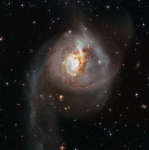 The Clash of NGC 3256
7.06.2018
Marked by an unusually bright central region, swirling dust lanes, and far flung tidal tails, peculiar NGC 3256 is the aftermath of a truly cosmic collision. The 500 million year old clash of two separate galaxies spans some 100 thousand light-years in this sharp Hubble view.
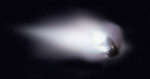 Comet Halleys Nucleus: An Orbiting Iceberg
4.01.2010
What does a comet nucleus look like? Formed from the primordial stuff of the Solar System, comet nuclei were thought to resemble very dirty icebergs. But ground-based telescopes revealed only the surrounding cloud of gas and dust of active comets nearing the Sun, clearly resolving only the comet's coma, and the characteristic cometary tails.
|
January February March April May June July August September |
|||||||||||||||||||||||||||||||||||||||||||||||||