
|
You entered: composite image
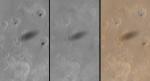 The Shadow of Phobos
17.09.2005
(xxxedit and linkxxx) Hurtling through space above the Red Planet, potato-shaped Phobos completes an orbit of Mars in less than eight hours. In fact, since its orbital period is shorter than the planet...
 SDO: The Extreme Ultraviolet Sun
23.04.2010
Don't panic, the Sun has not gone wild. But this wild-looking portrait of the nearest star to planet Earth was made on March 30th by the recently launched Solar Dynamics Observatory (SDO). Shown in false-color, the composite view covers extreme ultraviolet wavelengths and traces hot plasma at temperatures approaching 1 million kelvins.
GB-finalLeshin1024.preview.jpg) The Elephant s Trunk Nebula in Cepheus
The Elephant s Trunk Nebula in Cepheus
19.01.2017
Like an illustration in a galactic Just So Story, the Elephant's Trunk Nebula winds through the emission nebula and young star cluster complex IC 1396, in the high and far off constellation of Cepheus. Also known as vdB 142, the cosmic elephant's trunk is over 20 light-years long.
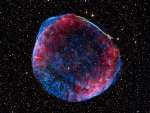 SN 1006 Supernova Remnant
12.07.2014
A new star, likely the brightest supernova in recorded human history, lit up planet Earth's sky in the year 1006 AD. The expanding debris cloud from the stellar explosion, found in the southerly constellation of Lupus, still puts on a cosmic light show across the electromagnetic spectrum.
 SN 1006 Supernova Remnant
1.08.2009
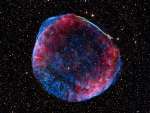
A new star, likely the brightest supernova in recorded human history, lit up planet Earth's sky in the year 1006 AD. The expanding debris cloud from the stellar explosion, found in the southerly constellation of Lupus, still puts on a cosmic light show across the electromagnetic spectrum.
 SN 1006 Supernova Remnant
4.07.2008
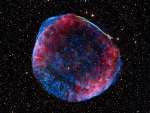
A new star, likely the brightest supernova in recorded human history, lit up planet Earth's sky in the year 1006 AD. The expanding debris cloud from the stellar explosion, found in the southerly constellation of Lupus, still puts on a cosmic light show across the electromagnetic spectrum.
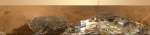 A Mars Panorama from the Phoenix Lander
13.03.2011
If you could stand on Mars, what would you see? The robotic Phoenix spacecraft that landed on Mars in 2008 recorded the above spectacular panorama. The above image is actually a digital combination of over 100 camera pointings and surveys fully 360 degrees around the busy robotic laboratory.
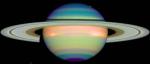 Infrared Saturn
24.07.1999
This delightfully detailed false color image of Saturn was earmarked to celebrate the 8th anniversary of the orbiting Hubble Space Telescope. The picture is a combination of three images taken in January 1998 and shows the lovely ringed planet in reflected infrared light.
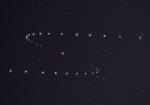 S is for Venus
7.01.2005
Planet Venus traced out this S shape in Earth's sky during 2004. Following the second planet from the Sun in a series of 29 images recorded from April 3rd through August...
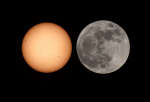 Sun vs Super Moon
11.05.2012
The Super Moon wins, by just a little, when its apparent size is compared to the Sun in this ingenious composite picture. To make it, the Full Moon on May 6 was photographed with the same camera and telescope used to image the Sun (with a dense solar filter!) on the following day.
|
January February March April May June July August September |
|||||||||||||||||||||||||||||||||||||||||||||||||