
|
You entered: Sun
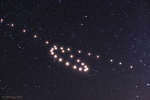 Mars in the Loop
8.11.2018
This composite of images spaced some 5 to 9 days apart, from late April (bottom right) through November 5 (top left), traces the retrograde motion of ruddy-colored Mars through planet Earth's night sky.
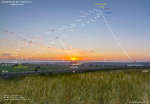 Sunset Analemma
21.06.2019
Today, the solstice is at 15:54 Universal Time, the Sun reaching the northernmost declination in its yearly journey through planet Earth's sky. A June solstice marks the astronomical beginning of summer in the northern hemisphere and winter in the south.
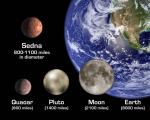 APOD: 2004 August 27- The Sedna Scenario
27.08.2004
The discovery of Sedna (aka 2003 VB12), the most distant known object orbiting the Sun, presents a mystery. Pluto's orbit averages about 40 AU in radius, where an AU (Astronomical Unit) is the Earth-Sun distance.
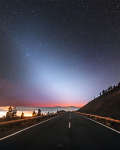 Zodiacal Road
24.07.2019
What's that strange light down the road? Dust orbiting the Sun. At certain times of the year, a band of sun-reflecting dust from the inner Solar System appears prominently just after sunset -- or just before sunrise -- and is called zodiacal light.
 APOD: 2023 November 1 Б Annular Solar Eclipse over Utah
1.11.2023
Part of the Sun disappeared earlier this month, but few people were worried. The missing part, which included the center from some locations, just went behind the Moon in what is known as an annular solar eclipse. Featured here is an eclipse sequence taken as the Moon was overtaking the rising Sun in the sky.
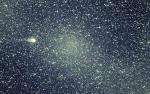 The Gegenschein
25.06.1999
If you look carefully enough, you can even see the glow of the Sun in the opposite direction. At night this glow is known as the gegenschein (German for "counter glow"), and can be seen as a faint glow in an extremely dark sky, as pictured above.
 APOD: 2023 September 10 Б An Annular Solar Eclipse over New Mexico
10.09.2023
What is this person doing? In 2012, an annular eclipse of the Sun was visible over a narrow path that crossed the northern Pacific Ocean and several western US states. In an annular solar...
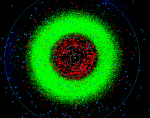 Our Busy Solar System
24.07.2002
Our Solar System is a busy place. Although the major planets get the most press, a swarm of rocks, comets, and asteroids also exist. The above plot shows the placement of known inner Solar System objects on 2002 July 20. The light blue lines indicate the orbits of planets.
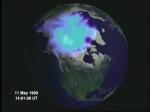 Unusual Aurora During Solar Wind Dropout
23.12.1999
On May 10, for some unknown reason, the Solar Wind virtually stopped. Normally our Sun emits a wind of between five and ten energetic particles per cubic centimeter moving outward at about 500 kilometers per second.
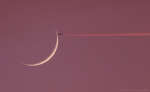 Fly Me to the Moon
17.01.2017
No, this is not a good way to get to the Moon. What is pictured is a chance superposition of an airplane and the Moon. The contrail would normally appear white, but the large volume of air toward the setting Sun preferentially knocks away blue light, giving the reflected trail a bright red hue.
|
January February March April May June July August September |
|||||||||||||||||||||||||||||||||||||||||||||||||