
|
You entered: Earth's moon
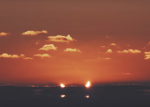 APOD: 2025 April 1 Б A Double Sunrise from a Partial Eclipse
1.04.2025
Can the Sun appear to rise twice at the same time? This was just the case a few days ago from Les Escoumins, Quebec, Canada as our Solar System's bright central orb rose just as it was being partially eclipsed by the Moon.
 Clusters, Hartley, and the Heart
14.10.2010
An alluring Comet Hartley 2 cruised through planet Earth's night sky on October 8, passing within about a Full Moon's width of the famous double star cluster in Perseus. The much anticipated...
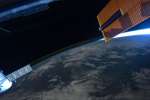 Perseid Below
10.08.2012
Denizens of planet Earth watched last year's Perseid meteor shower by looking up into the bright moonlit night sky. But this remarkable view captured on August 13, 2011 by astronaut Ron Garan looks down on a Perseid meteor.
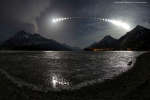 Waterton Lake Eclipse
17.04.2014
Recorded on April 15th, this total lunar eclipse sequence looks south down icy Waterton Lake from the Waterton Lakes National Park in Alberta, Canada, planet Earth. The most distant horizon includes peaks in Glacier National Park, USA.
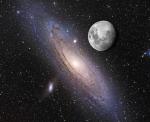 Moon Over Andromeda
28.12.2006
The Great Spiral Galaxy in Andromeda (aka M31), a mere 2.5 million light-years distant, is the closest large spiral to our own Milky Way. Andromeda is visible to the unaided eye as a small...
 Moon in the Hyades
20.04.2018
Have you seen the Moon lately? On April 18, its waxing sunlit crescent moved through planet Earth's night across a background of stars in the Hyades. Anchored by bright star Aldebaran, the nearby, V-shaped star cluster and complete lunar orb appear in this telephoto image.
 Eclipse in the Mist
4.06.2003
The Sun and Moon rose together over much of Europe on the morning of May 31st with the first solar eclipse of 2003 already in progress. And while sightings of the full annular phase...
 Cheering a Total Solar Eclipse
15.03.2016
What would you do if you saw the Sun disappear? Quite possibly: cheer. That's what many exuberant sky watchers did across Indonesia during a total eclipse of the Sun last week. There and then, the land and sky went dark during the day as our Sun disappeared for a few minutes behind our Moon.
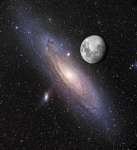 Moon Over Andromeda
1.08.2013
The Great Spiral Galaxy in Andromeda (aka M31), a mere 2.5 million light-years distant, is the closest large spiral to our own Milky Way. Andromeda is visible to the unaided eye as a small...
 A Sunrise at Sunset Point
19.10.2023
This timelapse series captured on October 14 is set against the sunrise view from Sunset Point, Bryce Canyon, planet Earth. Of course on that date the New Moon caught up with the Sun in the canyon's morning skies.
|
January February March April May June July August September |
|||||||||||||||||||||||||||||||||||||||||||||||||