
|
You entered: impact crater
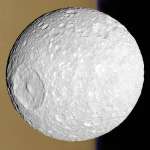 Mimas: Small Moon with a Big Crater
21.10.2014
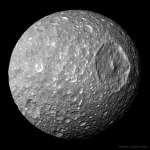
Whatever hit Mimas nearly destroyed it. What remains is one of the largest impact craters on one of Saturn's smallest moons. The crater, named Herschel after the 1789 discoverer of Mimas, Sir William Herschel, spans about 130 kilometers and is pictured above.
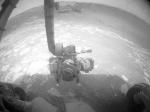 Inside Victoria Crater on Mars
17.09.2007
NASA's Opportunity rover is now inside Victoria Crater on Mars. Last week the robot rolled about 20 meters into the largest crater any Martian rover has yet encountered, the crater next to which Opportunity has been perched for months.
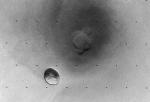 Phobos Over Mars
13.03.1999
Hurtling through space a mere 3,000 miles above the Martian surface, the diminutive moon Phobos (below and left of center) was imaged against the backdrop of a large shield volcano by the Viking 2 Orbiter in 1977.
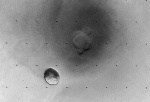 Phobos Over Mars
15.10.1996
Hurtling through space a mere 3,000 miles above the Martian surface, the diminutive moon Phobos (below and left of center) was imaged against the backdrop of a large shield volcano by the Viking 2 Orbiter in 1977.
 Mimas: Small Moon with a Big Crater
31.05.2021
Whatever hit Mimas nearly destroyed it. What remains is one of the largest impact craters on one of Saturn's smallest round moons. Analysis indicates that a slightly larger impact would have destroyed Mimas entirely.
 Phobos Over Mars
29.11.2003
Hurtling through space a mere 3,000 miles above the Martian surface, the diminutive moon Phobos (below and left of center) was imaged against the backdrop of a large shield volcano by the Viking 2 Orbiter in 1977.
 Crater Copernicus
13.05.2001
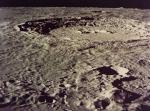
One of the more prominent craters on the Moon is named Copernicus. Copernicus is a large young crater visible with binoculars slightly northwest of the center of the Moon's Earth-facing hemisphere. Copernicus is distinguished by its size and by the many bright rays pointing out from it.
 Crater Copernicus
9.09.1998
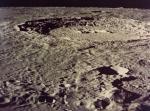
One of the more prominent craters on the Moon is named Copernicus. Copernicus is a large young crater visible with binoculars slightly northwest of the center of the Moon's Earth-facing hemisphere. Copernicus is distinguished by its size and by the many bright rays pointing out from it.
 APOD: 2025 January 12 Б Mimas: Small Moon with a Big Crater
12.01.2025
Whatever hit Mimas nearly destroyed it. What remains is one of the largest impact craters on one of Saturn's smallest round moons. Analysis indicates that a slightly larger impact would have destroyed Mimas entirely.
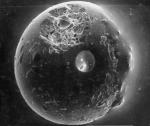 A Spherule from Outer Space
22.03.2000
When a meteorite strikes the Moon, the energy of the impact melts some of the splattering rock, a fraction of which might cool into tiny glass beads. Many of these glass beads were present in lunar soil samples returned to Earth by the Apollo missions.
|
January February March April May June July August September |
|||||||||||||||||||||||||||||||||||||||||||||||||