
|
You entered: hot gas
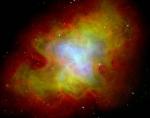 The Crab Nebula Pulsar Shrugs
20.09.2002
How does a city-sized neutron star power the vast Crab Nebula? The expulsion of wisps of hot gas at high speeds appears to be at least part of the answer. Yesterday time-lapse movies taken...
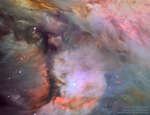 Dust, Gas, and Stars in the Orion Nebula
8.03.2017
The Great Nebula in Orion, an immense, nearby starbirth region, is probably the most famous of all astronomical nebulas. Here, filaments of dark dust and glowing gas surround hot young stars at the edge of an immense interstellar molecular cloud only 1500 light-years away.
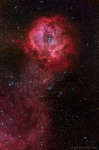 Long Stem Rosette Nebula
14.02.2021
Would the Rosette Nebula by any other name look as sweet? The bland New General Catalog designation of NGC 2237 doesn't appear to diminish the appearance of this flowery emission nebula, at the top of the image, atop a long stem of glowing hydrogen gas.
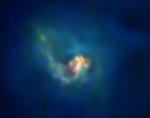 Centaurus Galaxy Cluster in X Rays
28.03.2002
The Centaurus Cluster is a swarm of hundreds of galaxies a mere 170 million light-years away. Like other immense galaxy clusters, the Centaurus Cluster is filled with gas at temperatures of 10 million degrees or more, making the cluster a luminous source of cosmic x-rays.
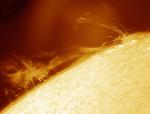 At the Edge of the Sun
7.07.2003
Dramatic prominences can sometimes be seen looming just beyond the edge of the sun. A solar prominence is a cloud of solar gas held just above the surface by the Sun's magnetic field. The Earth would easily fit below the prominence on the left.
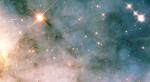 The Turbulent Neighborhood of Eta Carina
26.11.2003
How do violent stars affect their surroundings? To help find out, astronomers pointed the Hubble Space Telescope to the regions surrounding Eta Carina, a star showing signs that it may explode sometime in the next million years.
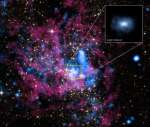 The Quiet Sagittarius A
6.09.2013
Hot gas is hard to swallow. At least that seems to be true for the supermassive black hole at the center of our Milky Way Galaxy. Known as source Sagittarius A*, the Milky Way's black hole is centered in this infrared (red and yellow hues) and X-ray (blue) composite.
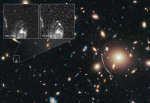 Galaxy Cluster Magnifies Distant Supernova
5.05.2014
How do you calibrate a huge gravitational lens? In this case the lens is the galaxy cluster Abell 383, a massive conglomeration of galaxies, hot gas, and dark matter that lies about 2.5 billion light years away (redshift z=0.187).
 At the Edge of the Helix
22.04.1996
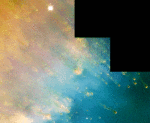
While exploring the inner edge of the Helix Nebula with the Hubble Space Telescope's Wide Field Planetary Camera 2, astronomers were able to produce this striking image - rich in details of an exotic environment.
 At the Edge of the Helix
20.07.1997
While exploring the inner edge of the Helix Nebula with the Hubble Space Telescope's Wide Field Planetary Camera 2, astronomers were able to produce this striking image - rich in details of an exotic environment.
|
January February March April May June July August September |
|||||||||||||||||||||||||||||||||||||||||||||||||