
|
You entered: extreme ultraviolet
 A Lonely Neutron Star
26.09.1997
How massive can a star get without imploding into a black hole? These limits are being tested by the discovery of a lone neutron star in space. Observations by the Hubble Space Telescope released...
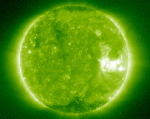 The Iron Sun
21.05.1996
The ultraviolet light emitted by eleven times ionized iron at temperatures over 2 million degrees Farenheit was used to record the above picture of the Sun on May 16. The image was made by the EIT camera onboard the SOHO spacecraft, a space observatory which can continuously observe the Sun.
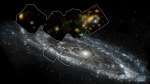 High Energy Andromeda
6.01.2016
A mere 2.5 million light-years away, the Andromeda Galaxy, also known as M31, really is just next door as large galaxies go. In this (inset) scan, image data from NASA's Nuclear Spectrosopic Telescope...
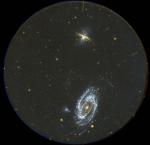 M81 and M82: GALEX Full Field
29.12.2004
Intriguing galaxy pair M81 and M82 shine in this full-field view from the orbiting GALEX observatory. GALEX - the Galaxy Evolution Explorer - scans the cosmos in ultraviolet light, a view that follows star formation and galaxy evolution through the Universe.
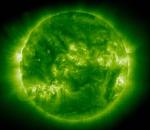 The Iron Sun
29.09.2001
The ultraviolet light emitted by eleven times ionized iron at temperatures over 2 million degrees Farenheit was used to record the above picture of the Sun on September 22, the date of the autumnal equinox.
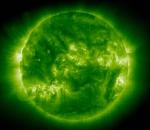 The Iron Sun
25.09.2004
The ultraviolet light emitted by eleven times ionized iron at temperatures over 2 million degrees Farenheit was used to record the above picture of the Sun on September 22, 2001, the date of that year's autumnal equinox.
 Biomarker Phosphine Discovered in the Atmosphere of Venus
14.09.2020
Could there be life floating in the atmosphere of Venus? Although Earth's planetary neighbor has a surface considered too extreme for any known lifeform, Venus' upper atmosphere may be sufficiently mild for tiny airborne microbes. This usually disfavored prospect took an unexpected upturn yesterday with the announcement of the discovery of Venusian phosphine.
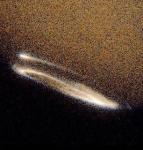 Jovian Aurora
22.01.1998
These two recently released Hubble Space Telescope close-ups show the Northern and Southern lights ... on Jupiter. Like aurora on Earth, these Jovian aurora are caused by charged particles funneled into the atmosphere above the planet's North (right) and South poles by magnetic fields.
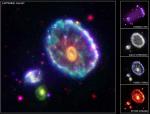 Cartwheel Of Fortune
17.01.2006
By chance, a collision of two galaxies has created a surprisingly recognizable shape on a cosmic scale - The Cartwheel Galaxy. The Cartwheel is part of a group of galaxies about 400 million light years away in the constellation Sculptor (two smaller galaxies in the group are visible below and left).
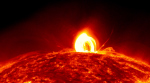 Coronal Rain on the Sun
26.05.2018
Does it rain on the Sun? Yes, although what falls is not water but extremely hot plasma. An example occurred in mid-July 2012 after an eruption on the Sun that produced both a Coronal Mass Ejection and a moderate solar flare. What was more unusual, however, was what happened next.
|
January February March April May June July August September |
|||||||||||||||||||||||||||||||||||||||||||||||||