
|
You entered: all sky
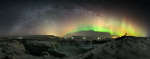 The Waterfall and the World at Night
17.05.2013
Above this boreal landscape, the arc of the Milky Way and shimmering aurorae flow through the night. Like an echo, below them lies Iceland's spectacular Godafoss, the Waterfall of the Gods. Shining just below the Milky Way, bright Jupiter is included in the panoramic nightscape recorded on March 9.
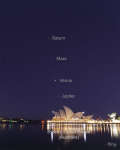 APOD: 2026 February 24 Б Planet Parade over Sydney Opera House
24.02.2026
Look up this week and see a whole bunch of planets. Just after sunset, looking west (mostly), planets Mercury, Venus, Saturn, and Jupiter will all be visible to the unaided eye simultaneously. If you have a telescope, planets Uranus and Neptune can also be seen.
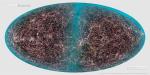 The 2MASS Galaxy Sky
26.06.2005
Are the nearest galaxies distributed randomly? A plot of over one million of the brightest "extended sources" detected by the Two Micron All Sky Survey (2MASS) shows that they are not. The vast majority of these infrared extended sources are galaxies.
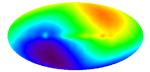 CMB Dipole: Speeding Through the Universe
28.01.2001
Our Earth is not at rest. The Earth moves around the Sun. The Sun orbits the center of the Milky Way Galaxy. The Milky Way Galaxy orbits in the Local Group of Galaxies. The Local Group falls toward the Virgo Cluster of Galaxies.
 A Geminid from Gemini
29.12.1998
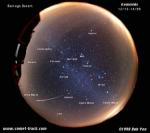
The Leonid meteor shower was not the only good meteor shower this season. Earlier this month, the annual Geminids meteor shower peaked, featuring as many as 140 meteors per hour from some locations. Geminid meteors can be seen streaking away from the constellation of Gemini, as depicted in the above all-sky photograph.
 Star Trails in Northern Skies
1.12.1996
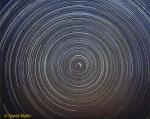
As the Earth spins on its axis, the sky seems to rotate around us. This motion produces the beautiful concentric arcs traced out by the stars in this time exposure of the night sky.
 Moon and Venus over Switzerland
2.02.2011
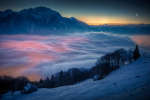
Sometimes a morning sky can be a combination of serene and surreal. Such a sky perhaps existed before sunrise this past Sunday as viewed from a snowy slope in eastern Switzerland. Quiet clouds blanket the above scene, lit from beneath by lights from the village of TrЭbbach.
 Dark Cloud
26.02.1999
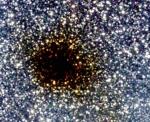
Ominously foreshadowing events to come, a dark cloud of obscuring dust stands out against a luminous star field in the Milky Way. Cataloged as Feitzinger and Stuwe object "1-457" this fuliginous interstellar nebula is relatively close - possibly only 1,000 light-years distant.
 CMBR Dipole: Speeding Through the Universe
8.05.2005
Our Earth is not at rest. The Earth moves around the Sun. The Sun orbits the center of the Milky Way Galaxy. The Milky Way Galaxy orbits in the Local Group of Galaxies. The Local Group falls toward the Virgo Cluster of Galaxies.
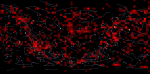 APOD Heatmap
16.06.2014
The first APOD appeared 19 years ago today. To help celebrate, APOD brings you today an all-sky heatmap of (nearly) 19 years of APOD entries. The brighter a region appears on the above heatmap, the more APODs that occur in that region.
|
January February March April May June July August September |
|||||||||||||||||||||||||||||||||||||||||||||||||