
|
You entered: VLT
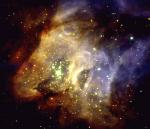 Star Forming Region RCW38
6.12.1998
Star cluster RCW38 was hiding. This open cluster of stars is located about 5000 light years away towards the constellation of Vela. Looking there will not normally reveal most of the stars in this cluster, though.
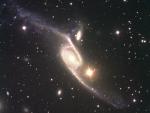 NGC 6872: A Stretched Spiral
25.05.1999
What makes NGC 6872 so long? Measuring over 700,000 light years across from top to bottom, NGC 6872 is one of the largest barred spiral galaxies known. The galaxy's elongated shape might have something to do with its continuing collision with the smaller galaxy IC 4970, visible just above center.
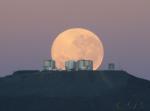 Paranal Moonset
3.11.2006
Just before the rising Sun fully illuminated the 2,635 meter summit of Cerro Paranal in northern Chile, Gordon Gillet captured this stunning moonset. In the telephoto picture, a nearly full October Moon is silhouetting the impressive array of telescopes at ESO's Paranal Observatory.
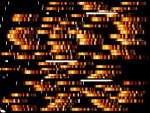 Breaking Distant Light
3.01.2009
In the distant universe, time appears to run slow. Since time-dilated light appears shifted toward the red end of the spectrum (redshifted), astronomers are able to use cosmological time-slowing to help measure vast distances in the universe.
 The Century that Defined Galaxy
29.12.1999
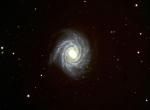
As the twentieth century dawned a debate raged over whether the Milky Way was the entire universe. The 1920s brought observations of spiral-nebulae that housed familiar but faint variable stars, and hence placed these nebulae much farther than anything else ever found. The Milky Way, apparently, is itself a spiral nebula seen from the inside.
 The Fornax Cluster of Galaxies
10.06.2016
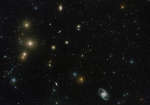
Named for the southern constellation toward which most of its galaxies can be found, the Fornax Cluster is one of the closest clusters of galaxies. About 62 million light-years away, it is almost...
 Unusual Starburst Galaxy NGC 1313
27.11.2006
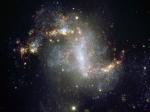
Why is this galaxy so discombobulated? Usually, galaxies this topsy-turvy result from a recent collision with a neighboring galaxy. Spiral galaxy NGC 1313, however, appears to be alone. Brightly lit with new and blue massive stars, star formation appears so rampant in NGC 1313 that it has been labeled a starburst galaxy.
 NGC 1850: Gas Clouds and Star Clusters
23.12.2000
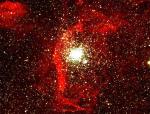
There's nothing like it in our own Galaxy. Globular clusters as young as NGC 1850 don't exist here. Globular clusters only 40 millions of years old can still be found in the neighboring LMC galaxy, though, but perhaps none so unusual as NGC 1850.
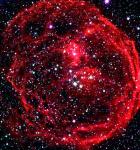 Henize 70: A Superbubble in the LMC
29.11.1999
Massive stars -- upwards of tens of times the mass of the Sun - profoundly affect their galactic environment. Churning and mixing the clouds of gas and dust between the stars, they leave their mark on the compositions and locations of future generations of stars and star systems.
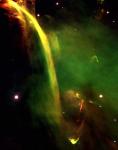 Arcs and Jets in Herbig Haro 34
28.11.1999
Some features of HH-34 are understood -- some are not. At the core of Herbig-Haro 34 lies a seemingly typical young star. This star, though, somehow ejects energetic "bullets" of high-energy particles, appearing as red streaks toward the lower right of the this image.
|
January February |
|||||||||||||||||||||||||||||||||||||||||||||||||