
|
You entered: Jupiter's Moons
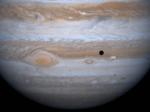 Jupiter, Io, and Shadow
25.12.2000
Just as planets orbit our Sun, Jupiter's Moons orbit Jupiter. Pictured above is the closest of Jupiter's Galilean Satellites, Io, superposed in front of the giant planet it circles. To the left of Io is a dark spot that is its own shadow.
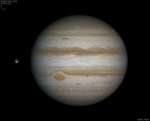 Jupiter, Ganymede, Great Red Spot
14.05.2015
In this sharp snapshot, the Solar System's largest moon Ganymede poses next to Jupiter, the largest planet. Captured on March 10 with a small telescope from our fair planet Earth, the scene also includes Jupiter's Great Red Spot, the Solar System's largest storm.
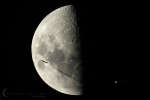 Fly Me to the Moons
25.02.2013
Sometimes the Moon is a busy direction. Last week, for example, our very Moon passed in front of the planet Jupiter. While capturing this unusual spectacle from New South Wales, Australia, a quick-thinking astrophotographer...
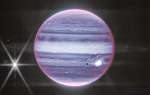 APOD: 2025 April 2 Б Jupiter and Ring in Infrared from Webb
1.04.2025
Why does Jupiter have rings? Jupiter's main ring was discovered in 1979 by NASA's passing Voyager 1 spacecraft, but its origin was then a mystery. Data from NASA's Galileo spacecraft that...
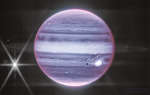 Jupiter and Ring in Infrared from Webb
19.07.2022
Why does Jupiter have rings? Jupiter's main ring was discovered in 1979 by NASA's passing Voyager 1 spacecraft, but its origin was then a mystery. Data from NASA's Galileo spacecraft that...
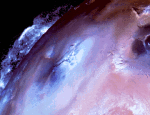 Erupting Volcanoes on Io
5.08.1996
Jupiter's moon Io has active volcanoes. The Voyager spacecraft caught several erupting when they passed the energetic moon in 1979. In the above picture, several of Io's volcanoes are visible and one is seen actually erupting.
 Venus and Jupiter are Far
2.07.2015
On June 30 Venus and Jupiter were actually far apart, but both appeared close in western skies at dusk. Near the culmination of this year's gorgeous conjunction, the two bright evening planets...
 APOD: 2025 September 1 Б Callisto: Dirty Battered Iceball
31.08.2025
Its surface is the most densely cratered in the Solar System -- but what's inside? Jupiter's moon Callisto is a battered ball of dirty ice that is larger than the planet Mercury.
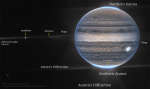 APOD: 2026 January 18 Б Jupiter from the Webb Space Telescope
17.01.2026
This infrared view of Jupiter by Webb is illuminating. High-resolution infrared images of Jupiter from the James Webb Space Telescope (Webb) reveal, for example, differences between high-floating bright clouds -- including the Great Red Spot -- and low-lying dark clouds.
 APOD: 2023 November 28 Б Ganymede from Juno
27.11.2023
What does the largest moon in the Solar System look like? Jupiter's moon Ganymede, larger than even Mercury and Pluto, has an icy surface speckled with bright young craters overlying a mixture of older, darker, more cratered terrain laced with grooves and ridges.
|
January February March April May June July August September |
|||||||||||||||||||||||||||||||||||||||||||||||||