
|
You entered: Earth's rotation
 Sky Full of SARs
17.08.2024
On August 11 a Rocket Lab Electron rocket launched from a rotating planet. With a small satellite on board its mission was dubbed A Sky Full of SARs (Synthetic Aperture Radar satellites), departing for low Earth orbit from Mahia Peninsula on New Zealand's north island.
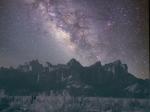 Heaven on Earth
23.02.2004
If sometimes it appears that the entire Milky Way Galaxy is raining down on your head, do not despair. It happens twice a day. As the Sun rises in the East, wonders of the night sky become less bright than the sunlight scattered by our own Earth's atmosphere, and so fade from view.
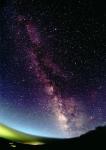 Heaven on Earth
6.11.2000
If sometimes it appears that the entire Milky Way Galaxy is raining down on your head, do not despair. It happens twice a day. As the Sun rises in the East, wonders of the night sky become less bright than the sunlight scattered by our own Earth's atmosphere, and so fade from view.
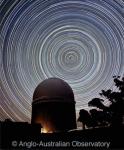 Star Trails in Southern Skies
15.07.2000
As the Earth spins on its axis, the stars seem to rotate around us. This motion produces the beautiful concentric arcs traced out by the stars in this time exposure of the southern hemisphere night sky. In the foreground is the dome of the Anglo-Australian Telescope in central New South Wales, Australia.
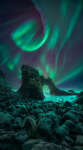 APOD: 2023 January 11 Б Spiral Aurora over Iceland
11.01.2023
The scene may look like a fantasy, but it's really Iceland. The rock arch is named Gatklettur and located on the island's northwest coast. Some of the larger rocks in the foreground span a meter across. The fog over the rocks is really moving waves averaged over long exposures.
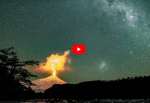 APOD: 2024 July 17 Б Villarrica Volcano Against the Sky
17.07.2024
When Vulcan, the Roman god of fire, swings his blacksmith's hammer, the sky is lit on fire. A recent eruption of Chile's Villarrica volcano shows the delicate interplay between this fire -- actually...
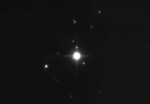 In Motion: Uranus and Moons
30.11.2021
What's that moving across the sky? A planet just a bit too faint to see with the unaided eye: Uranus. The gas giant out past Saturn was tracked earlier this month near opposition -- when it was closest to Earth and at its brightest.
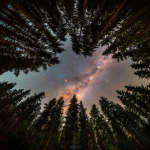 Framed by Trees: A Window to the Galaxy
19.07.2021
The photographer had this shot in mind for some time. He knew that objects overhead are the brightest -- since their light is scattered the least by atmospheric air. He also that knew the core of our Milky Way Galaxy was just about straight up near midnight around this time of year in South Australia.
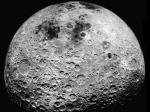 The Far Side of the Moon
25.02.2007
Does this moon look familiar? Possibly not, even though it is Earth's Moon. Locked in synchronous rotation, the Moon always presents its well-known near side to Earth. But from lunar orbit, Apollo astronauts also grew to know the Moon's far side.
 Geostationary Satellites Beyond the Alps
11.04.2012
Why don't those stars move? Stars in the sky will typically appear to rise and set as the Earth turns. Those far to the north or south will appear to circle the pole. If you look closely at the above time-lapse movie, however, there are points of light that appear stationary.
|
January February March April May June July August September October |
|||||||||||||||||||||||||||||||||||||||||||||||||