
|
You entered: young stars
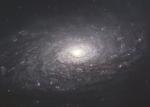 M63: The Sunflower Galaxy
27.06.2000
One of the bright spiral galaxies visible in the north sky is M63, the Sunflower Galaxy. M63, also catalogued as NGC 5055, can be found with a small telescope in the constellation of Canes Venaciti.
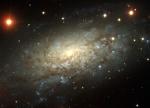 NGC 3621: Far Beyond the Local Group
5.06.2002
Far beyond the local group of galaxies lies NGC 3621, some 22 million light-years away. Found in the serpentine southern constellation Hydra, the loose spiral arms of this gorgeous island universe are loaded with luminous young star clusters and dark dust lanes.
 APOD: 2025 December 17 Б W5: The Soul Nebula
17.12.2025
Stars are forming in the Soul of the Queen of Aethopia. More specifically, a large star forming region called the Soul Nebula can be found in the direction of the constellation Cassiopeia, whom Greek mythology credits as the vain wife of a King who long ago ruled lands surrounding the upper Nile river.
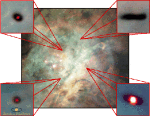 Planetary Systems Now Forming in Orion
7.12.1996
How do planets form? Astronomers are finding out by studying one of the most interesting of all astronomical nebulae known, the Great Nebula in Orion. Insets to above mosaic show several planetary systems in formation. The bottom left insert shows the relative size of our own Solar System. The Orion Nebula contains many stellar nurseries.
 The Elephant s Trunk in Cepheus
21.11.2024
Like an illustration in a galactic Just So Story, the Elephant's Trunk Nebula winds through the emission region and young star cluster complex IC 1396, in the high and far off constellation of Cepheus. Also known as vdB 142, this cosmic elephant's trunk is over 20 light-years long.
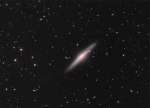 NGC 2683: Edge On Spiral Galaxy
17.03.2012
This elegant island universe is cataloged as NGC 2683. It lies a mere 16 million light-years distant toward the northern constellation Lynx. A spiral galaxy comparable to our own Milky Way, NGC 2683 is seen nearly edge-on in the cosmic vista.
 Panorama of the Whale Galaxy
17.05.2010
The see the full length of this blue whale, scroll right. NGC 4631 is a big beautiful spiral galaxy seen edge-on at only about 30 million light-years away. This galaxy's slightly distorted wedge shape led to its popular moniker of the Whale galaxy.
 NGC 604: Giant Stellar Nursery
25.04.2024
Located some 3 million light-years away in the arms of nearby spiral galaxy M33, giant stellar nursery NGC 604 is about 1,300 light-years across. That's nearly 100 times the size of the Milky Way's Orion Nebula, the closest large star forming region to planet Earth.
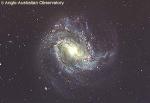 M83: A Barred Spiral Galaxy
26.09.1999
M83 is a bright spiral galaxy that can be found with a small telescope in the constellation of Hydra. It takes light about 15 million years to reach us from M83. M83 is quite a typical spiral - much like our own Milky Way Galaxy.
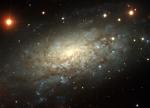 NGC 3621: Far Beyond the Local Group
19.07.2003
Far beyond the local group of galaxies lies NGC 3621, some 22 million light-years away. Found in the serpentine southern constellation Hydra, the loose spiral arms of this gorgeous island universe are loaded with luminous young star clusters and dark dust lanes.
|
January February March April May June July August September |
|||||||||||||||||||||||||||||||||||||||||||||||||