
|
You entered: star
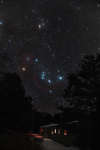 Northern Winter Night
24.12.2020
Orion always seems to come up sideways on northern winter evenings. Those familiar stars of the constellation of the Hunter are caught above the trees in this colorful night skyscape. Not a star at all but still visible to eye, the Great Nebula of Orion shines below the Hunter's belt stars.
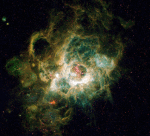 NGC 604: Giant Stellar Nursery in M33
16.08.1996
The nebula cataloged as NGC 604 is a giant star forming region, 1500 light years across, in the nearby spiral galaxy, M33. Seen here in a snapshot by the Hubble Space Telescope, over 200 newly formed, hot, massive, stars are scattered within a cavern-like, gaseous, interstellar cloud.
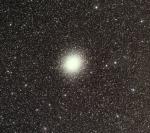 Omega Centauri
26.05.2006
Centaurus, the Centaur, is one of the most striking constellations in the southern sky. The Milky Way flows through this celestial expanse whose wonders also include the closest star to the sun, Alpha Centauri, and the largest globular star cluster in our galaxy, Omega Centauri.
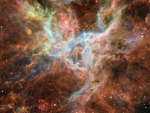 In the Heart of the Tarantula Nebula
31.03.2009
In the heart of monstrous Tarantula Nebula lies huge bubbles of energetic gas, long filaments of dark dust, and unusually massive stars. In the center of this heart, is a knot of stars so dense that it was once thought to be a single star.
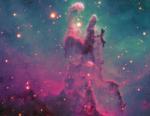 Eagle Castle
30.07.1997
What lights up this castle of star formation? The familiar Eagle Nebula glows much like a neon sign, but in many colors at once. The above photograph is a composite of three of these glowing gas colors.
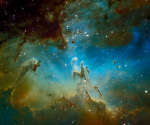 The Pillars of Eagle Castle
14.07.2013
What lights up this castle of star formation? The familiar Eagle Nebula glows bright in many colors at once. The above image is a composite of three of these glowing gas colors. Pillars of dark dust nicely outline some of the denser towers of star formation.
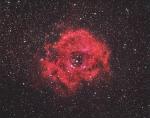 The Rosette Nebula
13.02.1998
Would the Rosette Nebula by any other name look as sweet? The bland New General Catalog designation of NGC 2237 doesn't appear to diminish the appearance of the this flowery emission nebula. Inside the nebula lies an open cluster of bright young stars designated NGC 2244.
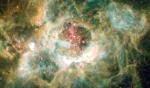 In the Center of NGC 604
4.03.1997
Stars are sometimes born in the midst of chaos. About 3 million years ago in the nearby galaxy M33, a large cloud of gas spawned dense internal knots which gravitationally collapsed to form stars. But NGC 604 was so large, it could form enough stars to make a globular cluster.
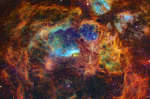 NGC 6357: The Lobster Nebula
27.10.2020
Why is the Lobster Nebula forming some of the most massive stars known? No one is yet sure. Cataloged as NGC 6357, the Lobster Nebula houses the open star cluster Pismis 24 near its center -- a home to unusually bright and massive stars.
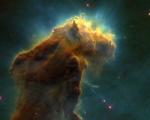 Eagle Eggs in M16
27.02.1998
Star forming regions known as "EGGs" are uncovered at the end of this giant pillar of gas and dust in the Eagle Nebula (M16). EGGs, short for evaporating gaseous globules, are dense regions of mostly molecular hydrogen gas that fragment and gravitationally collapse to form stars.
|
January February March April May June July August September |
|||||||||||||||||||||||||||||||||||||||||||||||||