
|
You entered: spiral galaxy
 APOD: 2024 July 14 Б Meteor Misses Galaxy
13.07.2024
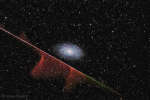
The galaxy was never in danger. For one thing, the Triangulum galaxy (M33), pictured, is much bigger than the tiny grain of rock at the head of the meteor. For another, the galaxy is much farther away -- in this instance 3 million light years as opposed to only about 0.0003 light seconds.
 NGC 4361: Galaxy Shaped Planetary Nebula
28.12.1995
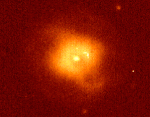
Glowing in the red light emitted by hydrogen atoms, the planetary nebula NGC 4361 is pictured above. The nebula itself is formed by the outer layers of gas shrugged off by the central star visible in the image.
 Star Streams of NGC 4216
26.11.2010
Some 40 million light-years distant, edge-on spiral galaxy NGC 4216 is nearly 100,000 light-years across, about the size of our own Milky Way. Found in the dense Virgo Galaxy Cluster, NGC 4216 is centered in this deep telescopic portrait flanked by fellow Virgo cluster members NGC 4206 (right) and NGC 4222.
 Meteor Misses Galaxy
29.04.2019
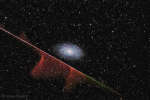
The galaxy was never in danger. For one thing, the Triangulum galaxy (M33), pictured, is much bigger than the tiny grain of rock at the head of the meteor. For another, the galaxy is much farther away -- in this instance 3 million light years as opposed to only about 0.0003 light seconds.
 M87: Elliptical Galaxy with Jet
20.05.2010
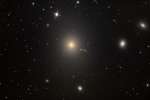
In spiral galaxies, majestic winding arms of young stars, gas, and dust rotate in a flat disk around a bulging galactic nucleus. But elliptical galaxies seem to be simpler. Lacking gas and dust to form new stars, their randomly swarming older stars, give them an ellipsoidal (egg-like) shape. Still, elliptical galaxies can be very large.
 M82: Galaxy with a Supergalactic Wind
22.07.2019
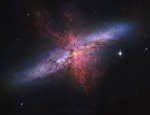
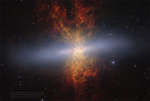
Why is the Cigar Galaxy billowing red smoke? M82, as this starburst galaxy is also known, was stirred up by a recent pass near large spiral galaxy M81. This doesn't fully explain the source of the red-glowing outwardly expanding gas and dust, however.
 APOD: 2023 August 2 Б M82: Galaxy with a Supergalactic Wind
1.08.2023
Why is the Cigar Galaxy billowing red smoke? M82, as this starburst galaxy is also known, was stirred up by a recent pass near large spiral galaxy M81. This doesn't fully explain the source of the red-glowing outwardly expanding gas and dust, however.
 Cometary Globule CG4
5.03.2015
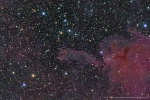
The faint and somehow menacing cometary globule CG4 reaches through the center of this deep southern skyscape. About 1,300 light-years from Earth toward the constellation Puppis, its head is about 1.5 light-years in diameter and its tail about 8 light-years long.
 APOD: 2026 June 29 Б M82: Galaxy with a Supergalactic Wind
28.06.2026
Why is the Cigar Galaxy billowing red smoke? M82, as this starburst galaxy is also known, was stirred up by a recent pass near large spiral galaxy M81. This doesn't fully explain the source of the red-glowing outwardly expanding gas and dust, however.
 NGC 1427A: Galaxy in Motion
3.03.2005
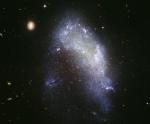
In this tantalizing image, young blue star clusters and pink star-forming regions abound in NGC 1427A, a galaxy in motion. The small irregular galaxy's swept back outline points toward the top of this...
|
January February March April May June July August September October |
|||||||||||||||||||||||||||||||||||||||||||||||||