
|
You entered: space
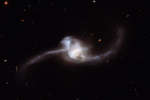 NGC 2623: Galaxy Merger from Hubble
9.11.2009
Where do stars form when galaxies collide? To help find out, astronomers imaged the nearby galaxy merger NGC 2623 in high resolution with the Hubble Space Telescope in 2007. Analysis of this Hubble image...
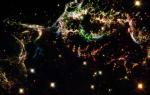 Recycling Cassiopeia A
12.07.2002
For billions of years, massive stars in our Milky Way Galaxy have lived spectacular lives. Collapsing from vast cosmic clouds, their nuclear furnaces ignite and create heavy elements in their cores. After a few million years, the enriched material is blasted back into interstellar space where star formation begins anew.
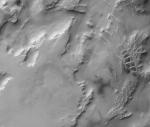 Rectangular Ridges on Mars
1.10.2002
What could cause rectangular ridges on Mars? As data flows in from the two spacecraft currently orbiting Mars, surface structures are seen that are not immediately understood. These structures pose puzzles that planetary geologists are eager to solve, as they might provide clues to past processes that have shaped Mars over billions of years.
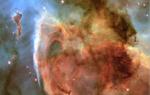 Colorful Clouds Of Carina
3.02.2000
Tumultuous clouds of the Carina Nebula, 8000 light-years away, glow in planet Earth's southern sky. Striking and detailed, this close-up of a portion of the famous nebula is a combination of exposures through six different filters taken with the Hubble Space Telescope's Wide Field Planetary Camera 2 in April of 1999.
 Meteors Over Quebec
16.08.2010
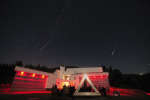
Meteors streaked through the sky above many of Earth's cities last week, but nobody was hurt, and no damage has been reported. The assault from space appeared to originate from someplace in the constellation of Perseus, and included millions of small projectiles hurtling toward Earth at over 200,000 kilometers per hour.
 GK Per: Nova of 1901
5.11.2011
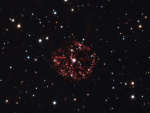
Early in the 20th century, GK Persei briefly became one of the brightest stars in planet Earth's sky, an event known as Nova Persei 1901. Documented in this modern day composite of two images from 2003 and 2011 the ejecta from the explosion, popularly called the Firework Nebula, continues to expand into space.
 APOD: 2025 October 3 Б Pandora's Cluster of Galaxies
3.10.2025
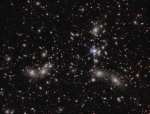
This deep field mosaicked image presents a stunning view of galaxy cluster Abell 2744 recorded by the James Webb Space Telescope's NIRCam. Also dubbed Pandora's Cluster, Abell 2744 itself appears to be a ponderous merger of three different massive galaxy clusters. It lies some 3.5 billion light-years away, toward the constellation Sculptor.
APOD: 2026 July 29 Б Psyche Receives Gravity Assist from Mars
29.07.2026
Solar System bodies make deep space exploration more fuel efficient! TodayБs video shows the Psyche spacecraft gaining speed and changing its trajectory with minimal fuel spent due to a gravity assist from Mars in May 2026. Mars has an average orbital speed of almost 87,000 km/h (54,000 mph) around the Sun.
 The Gullies Of Mars
23.06.2000
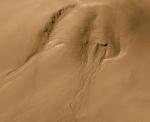
The recently revealed gullies on Mars are rare. But they may prove to be sites of present day, near surface, liquid water, holding out the tantalizing possibility of martian life. Too small to have...
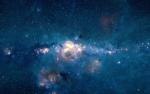 Journey to the Center of the Galaxy
25.10.2002
In Jules Verne's science fiction classic A Journey to the Center of the Earth, Professor Hardwigg and his fellow explorers encounter many strange and exciting wonders. What wonders lie at the center of our Galaxy?
|
January February March April May June July August September |
|||||||||||||||||||||||||||||||||||||||||||||||||