
|
You entered: nearest stars
 Curly Spiral Galaxy M63
19.05.2023
A bright spiral galaxy of the northern sky, Messier 63 is nearby, about 30 million light-years distant toward the loyal constellation Canes Venatici. Also cataloged as NGC 5055, the majestic island universe is nearly 100,000 light-years across, about the size of our own Milky Way.
 Mars, Antares, Moon, and Saturn
4.10.2014
Mars, Antares, Moon, and Saturn are the brightest celestial beacons in this serene sky. The Sun's golden light is still scattered along the southwestern horizon though, captured after sunset on September 28.
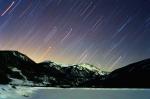 Orion Rising
25.12.2002
Orion always comes up sideways ... and was caught in the act earlier this month by astronomer Jimmy Westlake, stargazing eastward over the Rocky Mountains north of Leadville, Colorado, USA. To make this gorgeous image, Westlake placed his camera on a tripod for two exposures.
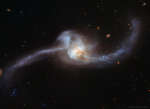 NGC 2623: Merging Galaxies from Hubble
10.01.2018
Where do stars form when galaxies collide? To help find out, astronomers imaged the nearby galaxy merger NGC 2623 in high resolution with the Hubble Space Telescope. Analysis of this and other Hubble images...
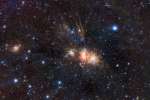 Vista with NGC 2170
15.10.2010
Drifting through the one-horned constellation Monoceros, these dusty streamers and new born stars are part of the active Monoceros R2 star-forming region, embedded in a giant molecular cloud. The cosmic scene was recorded by the VISTA survey telescope in near-infrared light.
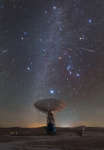 Geminids of the North
15.12.2017
Earth's annual Geminid meteor shower did not disappoint as our fair planet plowed through dust from active asteroid 3200 Phaethon. Captured in this northern hemisphere nightscape, the meteors stream away from the shower's radiant in Gemini.
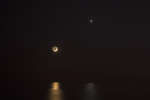 Reflections of Venus and Moon
19.05.2018
Posing near the western horizon, a brilliant evening star and slender young crescent shared reflections in a calm sea last Thursday after sunset. Recorded in this snapshot from the Atlantic beach at Santa Marinella...
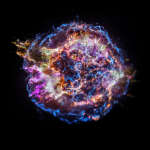 Recycling Cassiopeia A
28.12.2017
Massive stars in our Milky Way Galaxy live spectacular lives. Collapsing from vast cosmic clouds, their nuclear furnaces ignite and create heavy elements in their cores. After a few million years, the enriched material is blasted back into interstellar space where star formation can begin anew.
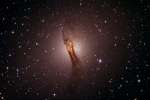 Centaurus A
13.03.2010
Only 11 million light-years away, Centaurus A is the closest active galaxy to planet Earth. Spanning over 60,000 light-years, the peculiar elliptical galaxy, also known as NGC 5128, is featured in this sharp color image.
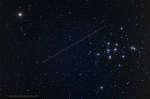 Close Encounter with M44
28.01.2015
On Monday, January 26, well-tracked asteroid 2004 BL86 made its closest approach, a mere 1.2 million kilometers from our fair planet. That's about 3.1 times the Earth-Moon distance or 4 light-seconds away. Moving...
|
January February March April May June July August September October |
|||||||||||||||||||||||||||||||||||||||||||||||||