
|
You entered: NASA
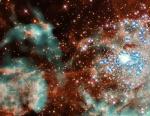 Star Cluster R136 Bursts Out
30.07.2001
In the center of star-forming region 30 Doradus lies a huge cluster of the largest, hottest, most massive stars known. Known as R136, the cluster's energetic stars are breaking out of the cocoon of gas and dust from which they formed.
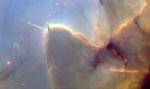 Trifid Pillars and Jets
30.12.2001
Dust pillars are like interstellar mountains. They survive because they are more dense than their surroundings, but they are being slowly eroded away by a hostile environment. Visible in the above picture...
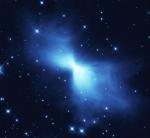 Cold Wind from the Boomerang Nebula
20.02.2003
A cold wind blows from the central star of the Boomerang Nebula. Seen here in a detailed false-color image recorded in 1998 by the Hubble Space Telescope, the nebula lies about 5,000 light-years away towards the grand southern constellation of Centaurus.
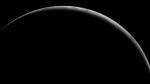 A Crescent Earth at Midnight
21.06.2003
The Earth's northern hemisphere is outlined as a sunlit crescent in this dramatic view from orbit, recorded near local midnight by the Geostationary Operational Environmental Satellite (GOES-8) on June 22, 1996. That...
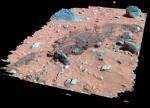 Martian Surface in Perspective
16.01.2004
Spirit moved across Mars yesterday as the rover successfully maneuvered down off its lander, driving its six wheels onto the floor of Gusev crater. As planned, the robotic geologist will now begin a close-up examination of the rocks and soil around the landing site for clues to the processes that formed them.
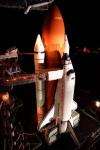 John Glenn: Discovery Launch
30.10.1998
At left, the Space Shuttle Discovery waits in darkness on Kennedy Space Center's launch pad 39B. At right, on Thursday October 29, Discovery blasts through a bright afternoon sky returning Senator John Glenn to space over 36 years after he became the first American in orbit.
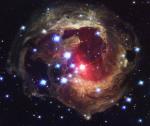 V838 Mon: Light Echo Update
4.02.2005
Expanding light echoes continue to illuminate the dusty environs of V838 Monocerotis, mysterious variable star near the edge of our Galaxy. This stunning image, produced from Hubble data recorded in October of 2004, adds to a unique series of space-based, high-resolution views.
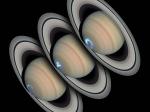 Persistent Saturnian Auroras
22.02.2005
Are Saturn's auroras like Earth's? To help answer this question, the Hubble Space Telescope and the Cassini spacecraft monitored Saturn's South Pole simultaneously as Cassini closed in on the gas giant in January 2004. Hubble snapped images in ultraviolet light, while Cassini recorded radio emissions and monitored the solar wind.
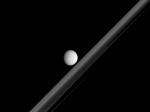 Saturnian Moon and Rings
18.04.2005
When can a robot produce art? When it glides past the rings of Saturn, for one. As the robot spacecraft Cassini orbiting Saturn crossed outside the famous photogenic ring plane of the expansive planet, the rings were imaged from the outside, nearly edge on, and in the shadow of Saturn.
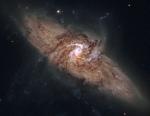 NGC 3314: When Galaxies Overlap
7.05.2005
NGC 3314 consists of two large spiral galaxies which just happen to almost exactly line-up. The foreground spiral is viewed nearly face-on, its pinwheel shape defined by young bright star clusters. But against the glow of the background galaxy, dark swirling lanes of interstellar dust are also seen to echo the face-on spiral's structure.
|
January February |
|||||||||||||||||||||||||||||||||||||||||||||||||