
|
You entered: young stars
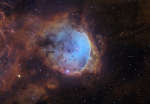 NGC 3324 in Carina
6.04.2018
This bright cosmic cloud was sculpted by stellar winds and radiation from the hot young stars of open cluster NGC 3324. With dust clouds in silhouette against its glowing atomic gas, the pocket-shaped star-forming region actually spans about 35 light-years. It lies some 7,500 light-years away toward the nebula rich southern constellation Carina.
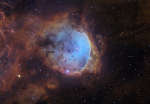 NGC 3324 in Carina
16.03.2019
This bright cosmic cloud was sculpted by stellar winds and radiation from the hot young stars of open cluster NGC 3324. With dust clouds in silhouette against its glowing atomic gas, the pocket-shaped star-forming region actually spans about 35 light-years. It lies some 7,500 light-years away toward the nebula rich southern constellation Carina.
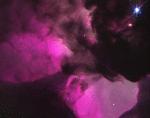 A Close-Up of the Lagoon's Hourglass
21.08.1996
In the central part of the Lagoon Nebula lies the above pictured Hourglass Nebula. In this region of recent star formation, obscuring dark lanes of dust permeate the red-glowing hydrogen gas. Blocking some...
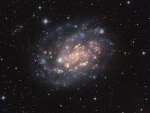 NGC 300: A Cosmic Gemstone with Stars and Gas Clouds
16.07.2026
This sparkling, colorful gemstone is a spiral galaxy, NGC 300. It is one of the closest spiral galaxies to Earth, only about 6 million light-years away. But does it really look like this? Here is a more standard portrait of it.
 Double Cluster in Perseus
3.01.2009
Some 7,000 light-years away, this pair of open or galactic star clusters is an easy binocular target, a lovely starfield in the northern constellation Perseus. Also visible to the unaided eye from dark sky areas, it was cataloged in 130 BC by Greek astronomer Hipparchus.
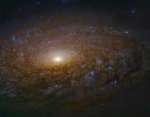 NGC 3521 Close Up
13.01.2011
Gorgeous spiral galaxy NGC 3521 is a mere 35 million light-years distant, toward the constellation Leo. Spanning some 50,000 light-years, its central region is shown in this dramatic image, constructed from data drawn from the Hubble Legacy Archive.
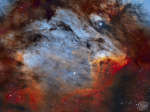 The Pelican Nebula in Gas, Dust, and Stars
25.09.2019
The Pelican Nebula is slowly being transformed. IC 5070, the official designation, is divided from the larger North America Nebula by a molecular cloud filled with dark dust. The Pelican, however, receives much study because it is a particularly active mix of star formation and evolving gas clouds.
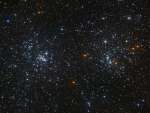 Double Cluster in Perseus
7.12.2007
Skygazers recently following Comet Holmes have probably also chanced across this lovely starfield, not far from the comet on the sky in the constellation Perseus. Some 7,000 light-years away, this pair of open or galactic star clusters is an easy binocular target and is visible to the unaided eye from dark sky areas.
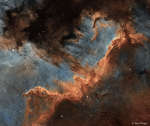 The Cygnus Wall of Star Formation
11.10.2016
Sometimes, stars form in walls -- bright walls of interstellar gas. In this vivid skyscape, stars are forming in the W-shaped ridge of emission known as the Cygnus Wall. Part of a larger emission nebula with a distinctive outline popularly called The North America Nebula, the cosmic ridge spans about 20 light-years.
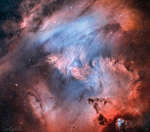 Wide Field: Fox Fur, Unicorn, and Christmas Tree
10.03.2020
What do the following things have in common: a cone, the fur of a fox, and a Christmas tree? Answer: they all occur in the constellation of the unicorn (Monoceros). Pictured as a star...
|
January February March April May June July August September |
|||||||||||||||||||||||||||||||||||||||||||||||||