
|
You entered: ring galaxy
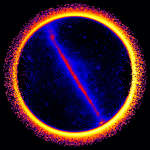 Gamma Ray Earth and Sky
6.12.2013
For an Earth-orbiting gamma-ray telescope, Earth is actually the brightest source of gamma-rays, the most energetic form of light. Gamma-rays from Earth are produced when high energy particles, cosmic rays from space, crash into the atmosphere.
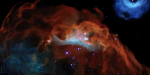 Journey into the Cosmic Reef
18.05.2020
What would you see if you could fly into the Cosmic Reef? The nebular cloud NGC 2014 appear to some like an ocean reef that resides in the sky, specifically in the LMC, the largest satellite galaxy of our Milky Way Galaxy.
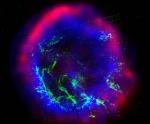 Supernova Remnant E0102 72 from Radio to X-Ray
14.04.2000
Not all stars form a big Q after they explode. The shape of supernova remnant E0102-72, however, is giving astronomers a clue about how tremendous explosions disperse elements and interact with surrounded gas. The above image is a composite of three different photographs in three different types of light.
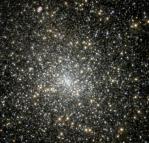 M15: Dense Globular Star Cluster
4.08.2000
Life might get dull at the core of M15 but the sky would always be bright with stars! In fact, only 40,000 light-years away in the constellation Pegasus, M15 is one of the most densely packed globular star clusters in our Milky Way Galaxy.
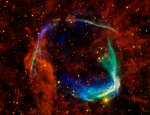 RCW 86: Historical Supernova Remnant
10.11.2011
In 185 AD, Chinese astronomers recorded the appearance of a new star in the Nanmen asterism - a part of the sky identified with Alpha and Beta Centauri on modern star charts. The new star was visible for months and is thought to be the earliest recorded supernova.
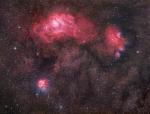 Sagittarius Triplet
9.09.2004
These three bright nebulae are often featured in telescopic tours of the constellation Sagittarius and the view toward the center of our Milky Way galaxy. In fact, 18th century cosmic tourist Charles Messier cataloged two of them; M8, the nebula above and left of center, and colorful M20 at the lower left.
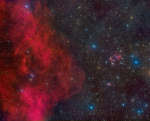 Barnard Stares at NGC 2170
19.01.2013
A gaze across a cosmic skyscape, this telescopic mosaic reveals the continuous beauty of things that are. The evocative scene spans some 6 degrees or 12 Full Moons in planet Earth's sky. At the left, folds of red, glowing gas are a small part of an immense, 300 light-year wide arc.
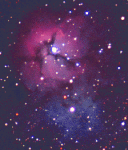 M20: The Trifid Nebula
23.07.1995
The vivid blue and violet colors present in the Trifid Nebula result from the abundance of young stars there. The light from young massive stars is quite blue and has the ability to remove electrons from surrounding gas. When these electrons re-combine with the gas, radiation rich in blue and violet light is emitted.
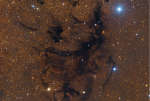 LDN 673: Dark Clouds in Aquila
29.10.2022
Part of a dark expanse that splits the crowded plane of our Milky Way galaxy, the Aquila Rift arcs through planet Earth's skies near bright star Altair. In eerie silhouette against the Milky...
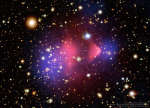 Sonified: The Matter of the Bullet Cluster
16.12.2020
What's the matter with the Bullet Cluster? This massive cluster of galaxies (1E 0657-558) creates gravitational lens distortions of background galaxies in a way that has been interpreted as strong evidence for the leading theory: that dark matter exists within.
|
January February March April May June July August September |
|||||||||||||||||||||||||||||||||||||||||||||||||