
|
You entered: telescope
 Webb's First Deep Field
15.07.2023
This stunning infrared image was released one year ago as the James Webb Space Telescope began its exploration of the cosmos. The view of the early Universe toward the southern constellation Volans was achieved in 12.5 hours of exposure with Webb's NIRCam instrument.
 Webb and Hubble: IC 5332
26.02.2026
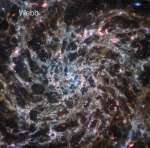
What does the universe look like through infrared goggles? Our eyes can only see visible light, but astronomers want to see more. TodayБs APOD shows spiral galaxy IC 5332 as seen by two NASA telescopes: Webb in mid-infrared and Hubble in ultraviolet and visible light.
 NGC 2623: Merging Galaxies from Hubble
10.01.2018
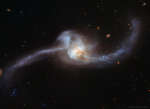
Where do stars form when galaxies collide? To help find out, astronomers imaged the nearby galaxy merger NGC 2623 in high resolution with the Hubble Space Telescope. Analysis of this and other Hubble images...
 APOD: 2025 July 16 Б The Rosette Nebula from DECam
16.07.2025
Would the Rosette Nebula by any other name look as sweet? The bland New General Catalog designation of NGC 2237 doesn't appear to diminish the appearance of this flowery emission nebula, as captured by the Dark Energy Camera (DECam) on the Blanco 4-meter telescope at the NSF's Cerro Tololo Inter-American Observatory in Chile.
 Fermi s Gamma-ray Moon
29.04.2016
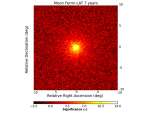
If you could only see gamma-rays, photons with up to a billion or more times the energy of visible light, the Moon would be brighter than the Sun! That startling notion underlies this novel...
 GRB 090423: The Farthest Explosion Yet Measured
29.04.2009
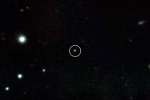
An explosion so powerful it was seen clear across the visible universe was recorded in gamma-radiation last week by NASA's orbiting Swift Observatory. Farther than any known galaxy, quasar, or optical supernova, the gamma-ray burst recorded last week was clocked at redshift 8.2, making it the farthest explosion of any type yet detected.
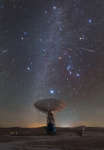 Geminids of the North
15.12.2017
Earth's annual Geminid meteor shower did not disappoint as our fair planet plowed through dust from active asteroid 3200 Phaethon. Captured in this northern hemisphere nightscape, the meteors stream away from the shower's radiant in Gemini.
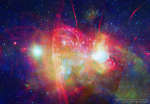 The Galactic Center from Radio to X ray
31.03.2020
In how many ways does the center of our Galaxy glow? This enigmatic region, about 26,000 light years away toward the constellation of the Archer (Sagittarius), glows in every type of light that we can see.
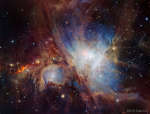 The Orion Nebula in Infrared from HAWK I
18.07.2016
The deepest infrared image of the Orion Nebula has uncovered a bonanza of previously unknown low-mass stars and -- quite possibly -- free floating planets. The picturesque nebula is best known in visible light where it shows a many bright stars and bright glowing gas.
 GRB 221009A
15.10.2022
Gamma-ray burst GRB 221009A likely signals the birth of a new black hole, formed at the core of a collapsing star long ago in the distant universe. The extremely powerful blast is depicted in this animated gif constructed using data from the Fermi Gamma Ray Space Telescope.
|
January February March April May |
|||||||||||||||||||||||||||||||||||||||||||||||||