
|
You entered: star cluster
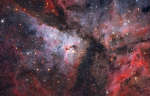 The Great Carina Nebula
27.12.2018
A jewel of the southern sky, the Great Carina Nebula, also known as NGC 3372, spans over 300 light-years, one of our galaxy's largest star forming regions. Like the smaller, more northerly Great...
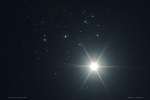 Venus and the Sisters
6.04.2012
After wandering about as far from the Sun on the sky as Venus can get, the brilliant evening star crossed paths with the Pleiades star cluster earlier this week. The beautiful conjunction was enjoyed by skygazers around the world. Taken on April 2, this celestial group photo captures the view from Portal, Arizona, USA.
 Spiral Galaxy NGC 2841
23.03.2023
A mere 46 million light-years distant, spiral galaxy NGC 2841 can be found in planet Earth's night sky toward the northern constellation of Ursa Major. This sharp image centered on the gorgeous island universe also captures spiky foreground Milky Way stars and more distant background galaxies within the same telescopic field of view.
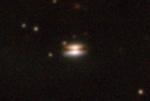 Portrait of an Infant Solar System
7.06.2002
This infant solar system was discovered posing along the lonely outskirts of the Rho Ophiuchi dark cloud, a star forming region 500 light-years from Earth. Enlarged in this infrared false-color portrait from the European...
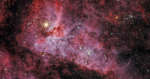 The Great Carina Nebula
27.05.2016
A jewel of the southern sky, the Great Carina Nebula, also known as NGC 3372, spans over 300 light-years, one of our galaxy's largest star forming regions. Like the smaller, more northerly Great...
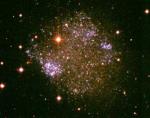 Irregular Galaxy Sextans A
14.11.1997
Grand spiral galaxies often seem to get all the glory. Their newly formed, bright, blue star clusters found along beautiful, symmetric spiral arms are guaranteed to attract attention. But small irregular galaxies form stars too, like this lovely, gumdrop-shaped galaxy, Sextans A.
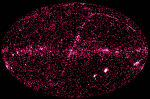 Exploring The Universe With IUE (1978-1996)
30.09.1996
How do planets, stars, and galaxies form? How do they evolve? The International Ultraviolet Explorer (IUE) satellite was launched in 1978 and operated by NASA/ ESA/ PPARC to help provide answers to some of the most fundamental questions about the contents of our universe.
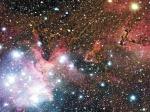 In the Center of the Heart Nebula
8.12.2004
What powers the Heart Nebula? The large emission nebula dubbed IC 1805 looks, in whole, like a human heart. The nebula glows brightly in red light emitted by its most prominent element: hydrogen. The red glow and the larger shape are all created by a small group of stars near the nebula's center.
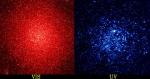 Globular Cluster Omega Centauri
15.10.2000
Does an old, red globular cluster have any hot, blue stars? The rightmost picture, taken by the Ultraviolet Imaging Telescope in ultraviolet light, shows that indeed it does. Pictured, Omega Centauri is the largest known globular cluster of over 200 in our Galaxy, containing well over a million stars.
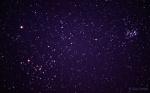 Saturn and Vesta in Taurus
18.01.2002
Last November, while skygazing toward the constellation Taurus, astrophotographer Joe Orman arranged this time exposure to include the lovely Hyades and Pleiades star clusters in the field of his telephoto lens. A distance...
|
January February March April May |
|||||||||||||||||||||||||||||||||||||||||||||||||