
|
You entered: hot star
 BOOMERANG Images The Early Universe
3.05.2000
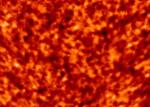
Drifting through the stratosphere above Antarctica in late 1998, the balloon-borne BOOMERANG telescope peered into the cosmos at millimeter wavelengths. The blotchy structures it detected are seen above in the sharpest yet picture of the universe at an early age, perhaps a mere 300,000 years old.
 AE Aurigae and the Flaming Star Nebula
9.11.2015
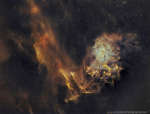
Is star AE Aurigae on fire? No. Even though AE Aurigae is named the flaming star, the surrounding nebula IC 405 is named the Flaming Star Nebula, and the region appears to have the color of fire, there is no fire.
 Free Floating Planets In Orion
31.03.2000
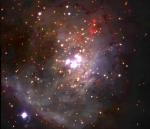
This false-colour image of the young Trapezium star cluster in the Orion Nebula was made with an infrared camera at wavelengths about twice as long as visible light. The infrared data are part...
 Lightning and Orion Beyond Uluru
10.05.2021
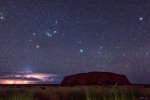
What's happening behind Uluru? A United Nations World Heritage Site, Uluru is an extraordinary 350-meter high mountain in central Australia that rises sharply from nearly flat surroundings. Composed of sandstone, Uluru has slowly formed over the past 300 million years as softer rock eroded away.
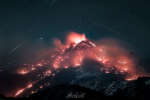 Stars over an Erupting Volcano
2.03.2021
Mt. Etna has been erupting for hundreds of thousands of years. Located in Sicily, Italy, the volcano produces lava fountains over one kilometer high. Mt. Etna is not only one of the most active...
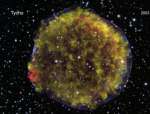 Tychos Supernova Remnant Expands
31.05.2016
What star created this huge expanding puffball? Featured here is the first expansion movie ever created for Tycho's supernova remnant, the result of a stellar explosion first recorded over 400 years ago by the famous astronomer Tycho Brahe.
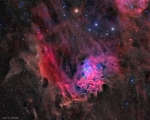 AE Aurigae and the Flaming Star Nebula
25.03.2019
Is star AE Aurigae on fire? No. Even though AE Aurigae is named the flaming star, the surrounding nebula IC 405 is named the Flaming Star Nebula, and the region shape gives the appearance of fire, there is no fire.
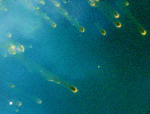 Cometary Knots in the Helix Nebula
16.04.1996
Four hundred fifty light-years from Earth, the wind from a dying, sun-like star produced a planetary nebula popularly known as the Helix. While exploring the Helix's gaseous envelope with the Hubble Space Telescope (HST), astronomers discovered indications of 1,000s of striking "cometary knots" like those shown above.
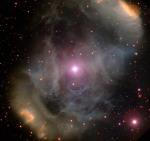 NGC 6164: A Bipolar Emission Nebula
6.06.2006
How did a star form this beautiful nebula? In the middle of emission nebula NGC 6164-5 is an unusually massive star nearing the end of its life. The star, visible in the center...
 APOD: 2024 April 24 Б Dragons Egg Bipolar Emission Nebula
23.04.2024
How did a star form this beautiful nebula? In the middle of emission nebula NGC 6164 is an unusually massive star. The central star has been compared to an oyster's pearl and an egg protected by the mythical sky dragons of Ara.
|
January February |
|||||||||||||||||||||||||||||||||||||||||||||||||