
|
You entered: full moon
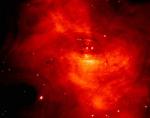 The Pulsar Powered Crab
2.06.2001
In the Summer of 1054 A.D. Chinese astronomers reported that a star in the constellation of Taurus suddenly became as bright as the full Moon. Fading slowly, it remained visible for over a year.
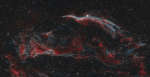 Along the Western Veil
6.09.2018
Delicate in appearance, these filaments of shocked, glowing gas, are draped across planet Earth's sky toward the constellation of Cygnus. They form the western part of the Veil Nebula. The Veil Nebula itself is a large supernova remnant, an expanding cloud born of the death explosion of a massive star.
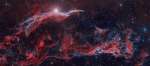 Along the Western Veil
4.04.2014
Delicate in appearance, these filaments of shocked, glowing gas, draped in planet Earth's sky toward the constellation of Cygnus, make up the western part of the Veil Nebula. The Veil Nebula itself is a large supernova remnant, an expanding cloud born of the death explosion of a massive star.
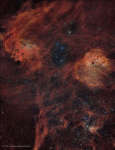 Nebulae in Aurigae
1.12.2015
Rich in star clusters and nebulae, the ancient constellation of the Charioteer (Auriga) rides high in northern winter night skies. Composed from narrow and broadband filter data and spanning nearly 8 Full Moons (4 degrees) on the sky, this deep telescopic view shows off some of Auriga's celestial bounty.
 The Tarantula Zone
8.03.2024
The Tarantula Nebula, also known as 30 Doradus, is more than a thousand light-years in diameter, a giant star forming region within nearby satellite galaxy the Large Magellanic Cloud. About 180 thousand light-years away, it's the largest, most violent star forming region known in the whole Local Group of galaxies.
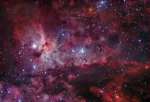 The Great Carina Nebula
9.06.2011
A jewel of the southern sky, the Great Carina Nebula, also known as NGC 3372, spans over 300 light-years, one of our galaxy's largest star forming regions. Like the smaller, more northerly Great...
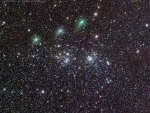 Two Custers and a Comet
30.01.2020
This lovely starfield spans some four full moons (about 2 degrees) across the heroic northern constellation of Perseus. In telescopic exposures made during the nights of January 24, 26, and 28 it holds...
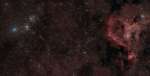 Clusters, Hartley, and the Heart
14.10.2010
An alluring Comet Hartley 2 cruised through planet Earth's night sky on October 8, passing within about a Full Moon's width of the famous double star cluster in Perseus. The much anticipated...
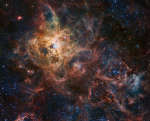 The Tarantula Zone
16.09.2022
The Tarantula Nebula, also known as 30 Doradus, is more than a thousand light-years in diameter, a giant star forming region within nearby satellite galaxy the Large Magellanic Cloud. About 180 thousand light-years away, it's the largest, most violent star forming region known in the whole Local Group of galaxies.
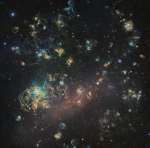 Clouds of the Large Magellanic Cloud
3.05.2019
The Large Magellanic Cloud (LMC) is an alluring sight in southern skies. But this deep and detailed telescopic view, over 10 months in the making, goes beyond what is visible to most circumnavigators of planet Earth.
|
January February March April May June July August September |
|||||||||||||||||||||||||||||||||||||||||||||||||