
|
You entered: emission nebula
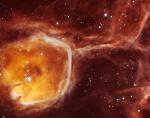 Windblown N44F
19.08.2004
A fast and powerful wind from a hot young star has created this stunning bubble-shaped nebula poised on the end of a bright filament of hydrogen gas. Cataloged as N44F, the cosmic windblown bubble is seen at the left of this Hubble Space Telescope image.
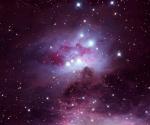 Reflections on the 1970s
2.10.2003
The 1970s are often overlooked. In particular, the beautiful grouping of reflection nebulae NGC 1977, NGC 1975, and NGC 1973 in Orion are often overlooked in favor of the substantial stellar nursery better known as the Orion Nebula.
 Aurora Australis and the International Space Station
13.09.2024
This snapshot from the International Space Station was taken on August 11 while orbiting about 430 kilometers above the Indian Ocean, Southern Hemisphere, planet Earth. The spectacular view looks south and east, down toward the planet's horizon and through red and green curtains of aurora australis.
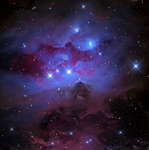 Reflections on the 1970s
18.12.2014
The 1970s are sometimes ignored by astronomers, like this beautiful grouping of reflection nebulae in Orion - NGC 1977, NGC 1975, and NGC 1973 - usually overlooked in favor of the substantial glow from the nearby stellar nursery better known as the Orion Nebula.
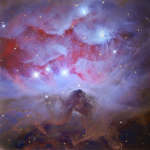 Reflections on the 1970s
13.01.2016
The 1970s are sometimes ignored by astronomers, like this beautiful grouping of reflection nebulae in Orion - NGC 1977, NGC 1975, and NGC 1973 - usually overlooked in favor of the substantial glow from the nearby stellar nursery better known as the Orion Nebula.
 The Fox Fur Nebula
30.12.2015
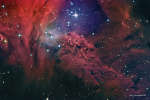
This interstellar canine is formed of cosmic dust and gas interacting with the energetic light and winds from hot young stars. The shape, visual texture, and color, combine to give the region the popular name Fox Fur Nebula.
 The Deep Lagoon
28.09.2023
Ridges of glowing interstellar gas and dark dust clouds inhabit the turbulent, cosmic depths of the Lagoon Nebula. Also known as M8, The bright star forming region is about 5,000 light-years distant. It makes for a popular stop on telescopic tours of the constellation Sagittarius toward the center of our Milky Way Galaxy.
 Antares and Rho Ophiuchi
9.05.2004
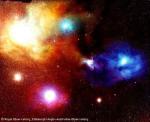
Why is the sky near Antares and Rho Ophiuchi so colorful? The colors result from a mixture of objects and processes. Fine dust illuminated from the front by starlight produces blue reflection nebulae. Gaseous clouds whose atoms are excited by ultraviolet starlight produce reddish emission nebulae. Backlit dust clouds block starlight and so appear dark.
 Antares and Rho Ophiuchi
22.09.1997
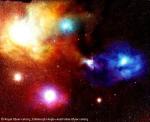
Why is the sky near Antares and Rho Ophiuchi so colorful? The colors result from a mixture of objects and processes. Fine dust illuminated from the front by starlight produces blue reflection nebulae. Gaseous clouds whose atoms are excited by ultraviolet starlight produce reddish emission nebulae. Backlit dust clouds block starlight and so appear dark.
 Colorful Clouds Near Rho Ophiuchi
28.08.2012
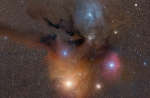
Why is the sky near Antares and Rho Ophiuchi so colorful? The colors result from a mixture of objects and processes. Fine dust illuminated from the front by starlight produces blue reflection nebulae. Gaseous clouds whose atoms are excited by ultraviolet starlight produce reddish emission nebulae. Backlit dust clouds block starlight and so appear dark.
|
January February March April May June July August September October |
|||||||||||||||||||||||||||||||||||||||||||||||||