
|
You entered: apod
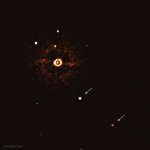 APOD: 2020 August 18 Б TYC 8998 760 1: Multiple Planets around a Sun Like Star
17.08.2020
Do other stars have planets like our Sun? Previous evidence shows that they do, coming mostly from slight shifts in the star's light created by the orbiting planets. Recently, however, and for the first time, a pair of planets has been directly imaged around a Sun-like star.
 APOD: 2024 February 27 Б Supernova Remnant Simeis 147
26.02.2024
It's easy to get lost following the intricate, looping, and twisting filaments of supernova remnant Simeis 147. Also cataloged as Sharpless 2-240, the filamentary nebula goes by the popular nickname the Spaghetti Nebula.
 APOD: 2024 March 17 Б NGC 7714: Starburst after Galaxy Collision
16.03.2024
Is this galaxy jumping through a giant ring of stars? Probably not. Although the precise dynamics behind the featured image is yet unclear, what is clear is that the pictured galaxy, NGC 7714, has been stretched and distorted by a recent collision with a neighboring galaxy.
 APOD: 2024 May 1 Б IC 1795: The Fishhead Nebula
30.04.2024
To some, this nebula looks like the head of a fish. However, this colorful cosmic portrait really features glowing gas and obscuring dust clouds in IC 1795, a star forming region in the northern constellation Cassiopeia.
 APOD: 2024 May 11 Б AR 3664: Giant Sunspot Group
10.05.2024
Right now, one of the largest sunspot groups in recent history is crossing the Sun. Active Region 3664 is not only big -- it's violent, throwing off clouds of particles into the Solar System. Some of these CMEs are already impacting the Earth, and others might follow.
 APOD: 2025 May 7 Б Galaxy Wars: M81 versus M82
6.05.2025
In the upper left corner, surrounded by blue arms and dotted with red nebulas, is spiral galaxy M81. In the lower right corner, marked by a light central line and surrounded by red glowing gas, is irregular galaxy M82.
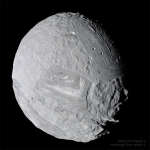 APOD: 2026 February 9 Б Miranda Revisited
8.02.2026
What is Miranda really like? Visually, old images from NASA's Voyager 2 have been recently combined and remastered to result in the featured image of Uranus's 500-kilometer-wide moon. In the late 1980s...
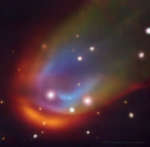 APOD: 2026 February 16 Б Unexplained Shocks Around a White Dwarf Star
15.02.2026
How is RXJ0528+2838 creating such shock waves? A recently discovered white dwarf star, the farther left of the two largest white spots, RXJ0528+2838, was found 730 light-years away from Earth. Most stars...
 APOD: 2023 July 31 Б Phobos over Mars
30.07.2023
Why is Phobos so dark? Phobos, the largest and innermost of the two Martian moons, is the darkest moon in the entire Solar System. Its unusual orbit and color indicate that it may be a captured asteroid composed of a mixture of ice and dark rock.
 APOD: 2025 November 30 Б The Surface of Titan from Huygens
29.11.2025
If you could stand on Titan -- what would you see? The featured color viewa from Titan gazes across an unfamiliar and distant landscape on Saturn's largest moon. The scene was recorded by ESA's Huygens probe in 2005 after a 2.5-hour descent through a thick atmosphere of nitrogen laced with methane.
|
January February March April May June July August September |
|||||||||||||||||||||||||||||||||||||||||||||||||