
|
You entered: dark cloud
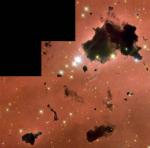 Thackeray's Globules
7.01.2002
Rich star fields and glowing hydrogen gas silhouette dense, opaque clouds of interstellar gas and dust in this Hubble Space Telescope close-up of IC 2944, a bright star forming region in Centaurus, 5,900 light-years away. The largest of these dark globules, first spotted by South African astronomer A. D.
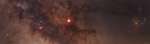 Eclipsed Moon in the Milky Way
17.06.2011
On June 15, the totally eclipsed Moon was very dark, with the Moon itself positioned on the sky toward the center of our Milky Way Galaxy. This simple panorama captures totality from northern Iran in 8 consecutive exposures each 40 seconds long.
 APOD: 2024 November 17 Б LDN 1471: A Windblown Star Cavity
16.11.2024
What is the cause of this unusual parabolic structure? This illuminated cavity, known as LDN 1471, was created by a newly forming star, seen as the bright source at the peak of the parabola.
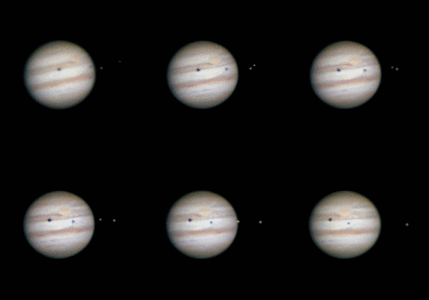 When Moons and Shadows Dance
26.02.2003
It's no wonder Jupiter is a favorite target for even modest earthbound telescopes. The most massive planet in the solar system with four of the largest moons also boasts the famous Great Red Spot, a giant hurricane-like storm system over three hundred years old.
 APOD: 2025 November 16 Б Crossing Saturns Ring Plane
15.11.2025
If this is Saturn, where are the rings? When Saturn's "appendages" disappeared in 1612, Galileo did not understand why. Later that century, it became understood that Saturn's unusual protrusions were rings and that when the Earth crosses the ring plane, the edge-on rings will appear to disappear.
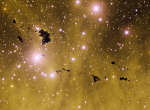 Thackerays Globules
12.06.2012
These are larger dust bunnies than you will find under your bed. Situated in rich star fields and glowing hydrogen gas, these opaque clouds of interstellar dust and gas are so large they might be able to form stars.
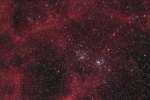 Double Cluster in Perseus
23.01.2014
This lovely starfield spans some seven full moons (about 3.5 degrees) across the heroic northern constellation of Perseus. Just right of center it holds the famous pair of open or galactic star clusters, h and Chi Perseii.
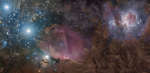 Orion in Gas, Dust, and Stars
29.09.2009
The constellation of Orion holds much more than three stars in a row. A deep exposure shows everything from dark nebula to star clusters, all imbedded in an extended patch of gaseous wisps in the greater Orion Molecular Cloud Complex.
 Orion in Gas, Dust, and Stars
12.02.2012
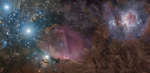
The constellation of Orion holds much more than three stars in a row. A deep exposure shows everything from dark nebula to star clusters, all embedded in an extended patch of gaseous wisps in the greater Orion Molecular Cloud Complex.
 Orion in Gas, Dust, and Stars
10.11.2014
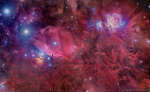
The constellation of Orion holds much more than three stars in a row. A deep exposure shows everything from dark nebula to star clusters, all embedded in an extended patch of gaseous wisps in the greater Orion Molecular Cloud Complex.
|
January February March April May June July August September |
|||||||||||||||||||||||||||||||||||||||||||||||||