
|
You entered: Milky Way
 A Magellanic Mural
3.02.1998
Two galaxies stand out to casual observers in Earth's Southern Hemisphere: the Large Magellanic Cloud (LMC) and the Small Magellanic Cloud (SMC). These irregular galaxies are two of the closest galaxies to our Milky Way Galaxy.
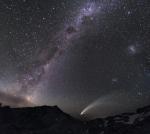 Three Galaxies and a Comet
30.03.2007
Diffuse starlight and dark nebulae along the southern Milky Way arc over the horizon and sprawl diagonally through this gorgeous nightscape. The breath-taking mosaic spans a wide 100 degrees, with the rugged terrain of the Patagonia, Argentina region in the foreground.
 A Cerro Tololo Sky
14.05.2001
High atop a Chilean mountain lies one of the premier observatories of the southern sky: Cerro Tololo. Pictured above is one of the premier telescopes of the Cerro Tololo Inter-American Observatory (CTIO) and of the past quarter-century: the 4-meter Blanco Telescope.
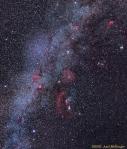 Clusters and Nebulae of the Hexagon
4.04.2003
At first, the bright stars of the large asterism known as the (northern) Winter Hexagon might be hard to pick out in this gorgeous deep sky mosaic from December 2002. But placing your cursor...
 A Slice Through an Artificial Universe
23.06.1998
We live in the era of humanity when most of our Universe is being mapped. To help understand these maps, astronomers computationally estimate the appearance of several possible candidate universes, to which maps of the real Universe can be compared.
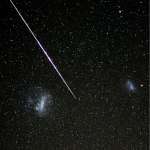 Meteor between the Clouds
20.11.2009
This bright meteor streaked through dark night skies over Sutherland, South Africa on November 15. Potentially part of the annual Leonid meteor shower, its sudden, brilliant appearance, likened to a camera's flash, was captured by chance as it passed between two clouds.
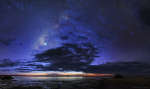 Night Hides the World
7.02.2014
Stars come out as evening twilight fades in this serene skyscape following the Persian proverb "Night hides the world, but reveals a universe." In the scene from last November, the Sun is setting over northern Kenya and the night will soon hide the shores of Lake Turkana, home to many Nile crocodiles.
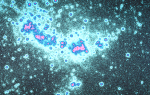 LMC Star Clouds
11.10.1995
Pictured above are clouds of young stars forming an arc in the nearby Large Magellanic Cloud, the nearest galaxy to the our Milky Way Galaxy. These stars are situated in a star forming region known as N 51.
 NGC 1365: A Nearby Barred Spiral Galaxy
13.04.2003
Many spiral galaxies have bars across their centers. Even our own Milky Way Galaxy is thought to have a bar, but perhaps not so prominent as the one in NGC 1365, shown above. The persistence and motion of the bar imply relatively massive spiral arms.
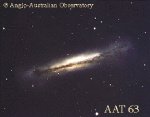 Spiral Galaxy NGC 3628 Edge On
1.11.1996
This is what a spiral galaxy looks like sideways. This view of NGC 3628 nearly resembles our own Milky Way Galaxy, which is also known to be a spiral. The dark band across the center is absorbed starlight caused by the galaxy's own interstellar dust.
|
January February March April May June July August September October |
|||||||||||||||||||||||||||||||||||||||||||||||||