
|
You entered: time
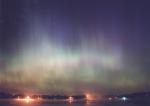 Aurora Persei
4.09.2000
Last month, skywatchers were treated to an unexpected coincidence: bright aurorae occurred during the Perseid Meteor Shower. The above picture was taken August 12 and captures eerie looking aurorae and a faint Perseid meteor above Cross Lake in Wisconsin, USA. The near future holds promise for both more aurorae and a better meteor shower.
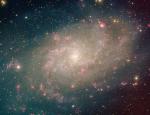 Nearby Spiral M33
2.12.2002
Spiral galaxy M33 is a mid-sized member of our Local Group of Galaxies. M33 is also called the Triangulum Galaxy for the constellation in which it resides. About four times smaller (in radius) than...
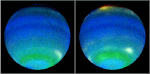 The Weather on Neptune
28.10.1996
Today's weather on Neptune will be typical. Highs in the upper atmosphere will be about -150 Centigrade, with winds ranging about 900 miles per hour near the equator. Much was learned recently about Neptune's weather by the release last week of time-lapse pictures of the most distant gas giant in our Solar System.
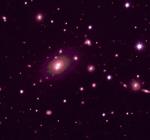 Galaxy Cluster A2199
22.01.1997
It's bigger than a bread box. In fact, it's much bigger than all bread boxes put together. Abell 2199 is huge. In fact, it is a close, large cluster of galaxies, containing several thousands of galaxies centered around a central dominant galaxy.
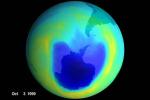 Ozone Hole Reduced
13.10.1999
Although a new ozone hole has formed again this year over the South Pole, this time it is a little bit smaller than the year before. Ozone is important because it shields us from damaging ultraviolet sunlight. Ozone is vulnerable, though, to CFCs and halons being released into the atmosphere.
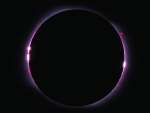 At the Sun s Edge
7.08.2008
A train trip on the Trans-Siberian railway to Novosibirsk resulted in this stunning view along the edge of the Sun recorded during the August 1st total solar eclipse. The picture is a composite...
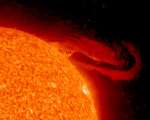 A Solar Prominence Unfurls
4.10.2008
On September 29, this magnificent eruptive solar prominence lifted away from the Sun's surface, unfurling into space over the course of several hours. Suspended in twisted magnetic fields, the hot plasma structure is many times the size of planet Earth and was captured in this view by the Sun-watching STEREO (Ahead) spacecraft.
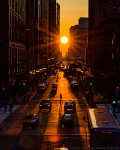 Chicagohenge: Equinox in an Aligned City
20.03.2018
Sometimes, in a way, Chicago is like a modern Stonehenge. The way is east to west, and the time is today. Today, and every equinox, the Sun will set exactly to the west, everywhere on Earth.
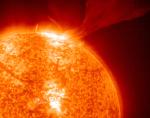 A Solar Prominence Erupts
24.09.2001
Our Sun is still very active. Last year, our Sun went though Solar Maximum, the time in its 11-year cycle where the most sunspots and explosive activities occur. Sunspots, the Solar Cycle, and solar prominences are all caused by the Sun's changing magnetic field.
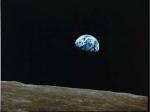 Earth Rise
27.01.2002
During 1968, the Apollo 8 crew flew from the Earth to the Moon and back. The crew, consisting of Frank Borman, James Lovell, and Willian Anders, were launched atop a Saturn V rocket on December 21, circled the Moon ten times in their command module, and landed back on Earth on December 27.
|
January February March April May June July August September |
|||||||||||||||||||||||||||||||||||||||||||||||||