
|
You entered: star system
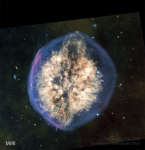 APOD: 2026 March 9 Б The Cranium Nebula from the Webb Telescope
9.03.2026
What's going on inside the head of this nebula? Dubbed the Exposed Cranium Nebula for its similarity to the human brain, what created the nebula remains a mystery. One thought is that the Cranium Nebula, also known as PMR 1, is a planetary nebula surrounding a white dwarf star.
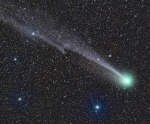 Long Lovejoy and Little Dumbbell
26.02.2015
Buffeted by the solar wind, Comet Lovejoy's crooked ion tail stretches over 3 degrees across this telescopic field of view, recorded on February 20. The starry background includes awesome bluish star Phi Persei below, and pretty planetary nebula M76 just above Lovejoy's long tail.
 APOD: 2024 December 22 Б The Local Fluff
22.12.2024
The stars are not alone. In the disk of our Milky Way Galaxy, about 10 percent of visible matter is in the form of gas called the interstellar medium (ISM). The ISM is not uniform and shows patchiness even near our Sun.
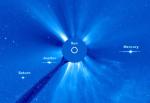 Planets In The Sun
5.05.2000
Today, all five naked-eye planets (Mercury, Venus, Mars, Jupiter, Saturn) plus the Moon and the Sun will at least approximately line-up. As viewed from planet Earth, they will be clustered within about 26 degrees, the closest alignment for all these celestial bodies since February 1962, when there was a solar eclipse!
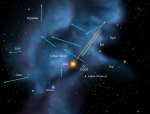 The Local Fluff
24.09.2013
The stars are not alone. In the disk of our Milky Way Galaxy about 10 percent of visible matter is in the form of gas, called the interstellar medium (ISM). The ISM is not uniform, and shows patchiness even near our Sun.
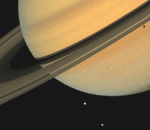 Saturn with Moons Tethys and Dione
31.05.1997
Saturn and two of its larger moons - Tethys and Dione - were photographed by the Voyager 1 spacecraft which flew by the planet in November of 1980. This picture gives an indication of Saturn's extensive ring system, which can be seen casting a shadow on the planet, as does Tethys.
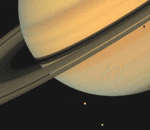 Saturn with Moons Tethys and Dione
18.03.1996
Saturn and two of its larger moons - Tethys and Dione - were photographed by the Voyager 1 spacecraft which flew by the planet in November of 1980. This picture gives an indication of Saturn's extensive ring system, which can be seen casting a shadow on the planet, as does Tethys.
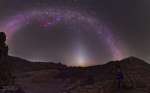 Zodiacal Light Vs. Milky Way
20.03.2010
Ghostly Zodiacal light, featured near the center of this remarkable panorama, is produced as sunlight is scattered by dust in the Solar System's ecliptic plane. In the weeks surrounding the March equinox (today...
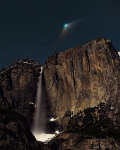 APOD: 2023 February 21 Б Comet ZTF over Yosemite Falls
21.02.2023
They are both falling. The water in Yosemite Falls, California, USA, is falling toward the Earth. Comet ZTF is falling toward the Sun. This double cosmic cascade was captured late last month as fading Comet C/2022 E3 (ZTF) had just passed its closest to planet Earth. The orange star just over the falls is Kochab.
 International Space Station Trail
14.12.2000
Still under construction, the International Space Station is literally becoming one of the brightest, fastest moving stars in the heavens. Despite illuminated clouds and bright light from a nearly full moon (lower left), this...
|
January February March April May June |
|||||||||||||||||||||||||||||||||||||||||||||||||