
|
You entered: star
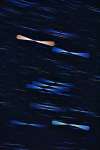 Star Colors in Orion
11.02.2011
What determines a star's color? Its temperature. Red stars are cool, with surface temperatures of around 3,000 kelvins (K), while blue stars are hotter and can have temperatures over 30,000 K. Our own lovely "yellow" Sun's temperature is a comforting 6,000 K.
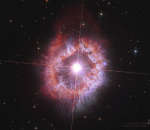 The Outburst Clouds of Star AG Car
26.05.2021
What created these unusual clouds? At the center of this 2021 Hubble image sits AG Carinae, a supergiant star located about 20,000 light-years away in the southern constellation Carina. The star's emitted...
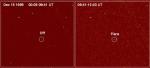 LP 944-20: A Failed Star Flares
13.07.2000
The tiny spot circled on the right actually represents a big astronomical discovery -- the first detected flare from a failed star. Failed stars, termed brown dwarfs in astronomers' parlance, are too low in mass to ignite nuclear hydrogen burning in their cores, yet
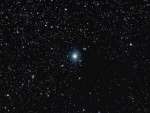 The Mystery of the Fading Star
8.01.2010
Every 27 years Epsilon Aurigae fades, remaining dim for roughly two years before growing bright again. Since the 19th century, astronomers have studied the mystery star, eventually arguing that Epsilon Aur, centered in this telescopic skyview, was actually undergoing a long eclipse by a dark companion object.
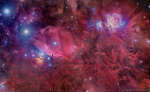 Orion in Gas, Dust, and Stars
10.11.2014
The constellation of Orion holds much more than three stars in a row. A deep exposure shows everything from dark nebula to star clusters, all embedded in an extended patch of gaseous wisps in the greater Orion Molecular Cloud Complex.
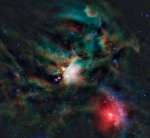 Young Stars in the Rho Ophiuchi Cloud
14.04.2011
Dust clouds and embedded newborn stars glow at infrared wavelengths in this tantalizing false-color composition from WISE, the Wide-field Infrared Survey Explorer. The cosmic canvas features one of the closest star forming regions, part of the Rho Ophiuchi cloud complex some 400 light-years distant near the southern edge of the pronounceable constellation Ophiuchus.
 WR 104: A Pinwheel Star System
3.06.2014
Might this giant pinwheel one-day destroy us? Probably not, but investigation of the unusual star system Wolf-Rayet 104 has turned up an unexpected threat. The unusual pinwheel pattern has been found to be created by energetic winds of gas and dust that are expelled and intertwine as two massive stars orbit each other.
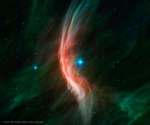 Zeta Oph: Runaway Star
2.02.2020
Like a ship plowing through cosmic seas, runaway star Zeta Ophiuchi produces the arcing interstellar bow wave or bow shock seen in this stunning infrared portrait. In the false-color view, bluish Zeta...
 APOD: 2025 June 23 Б W5: Pillars of Star Formation
23.06.2025
How do stars form? Images of the star forming region W5 like those in the infrared by NASA's Wide Field Infrared Survey Explorer (WISE, later NEOWISE) satellite provide clear clues with indications that massive stars near the center of empty cavities are older than stars near the edges.
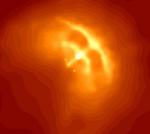 Vela Pulsar: Neutron Star-Ring-Jet
9.06.2000
This stunning image from the orbiting Chandra X-ray Observatory is centered on the Vela pulsar -- the collapsed stellar core within the Vela supernova remnant some 800 light-years distant. The Vela pulsar is a neutron star. More massive than the Sun, it has the
|
January February March April May June July August September |
|||||||||||||||||||||||||||||||||||||||||||||||||