
|
You entered: Mars
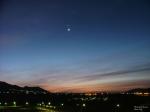 Moon Over Shiraz
13.11.2004
Early morning risers around the world have enjoyed the sight of bright planets in this week's predawn skies - further enhanced by the celestial spectacle of the waning crescent Moon. From some locations the Moon was seen to pass in front of Jupiter or Venus, a lunar occultation.
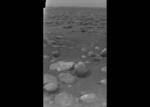 Huygens Images Titan s Surface
15.01.2005
After a seven year interplanetary voyage on board the the Cassini spacecraft, the European Space Agency's Huygens probe parachuted to a historic landing on Saturn's moon Titan on January 14. Above...
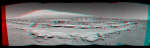 Mount Sharp on the Horizon
8.03.2014
Get out your red/blue glasses (red for the left eye) and look out over this expansive martian landscape. The panoramic stereo view is composed of images from the roving Curiosity's Navcam taken at a rest stop during a 100 meter drive on Sol 548 (February 19).
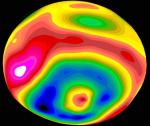 A Map of Asteroid Vesta
8.09.1997
Vesta is a huge rock 500 kilometers across that orbits out past Mars. Last week, the above map of Vesta created using the Hubble Space Telescope was released showing a rugged surface highlighted by a single crater spanning nearly the entire length of the asteroid.
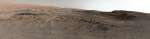 Curiosity s View
8.08.2015
By planet Earth's calendar, the Curiosity Mars Rover reached its 3rd anniversary on the surface of the Red Planet on August 6. To celebrate, gaze across this dramatic panoramic view of diverse terrain typical of the rover's journey to the layered slopes of Aeolis Mons, also known as Mount Sharp.
 Planet Line over New York Bridge
20.04.2022
There's an interesting sky to see if you wake up before the Sun. Lined up on toward the eastern horizon are four planets in a row. The planets are so bright they can even be seen from the bright sky inside a city.
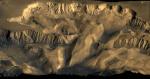 Candor and Ophir Chasmata
18.02.2003
First imaged by the Mariner 9 spacecraft, Valles Marineris, the grand canyon of Mars, is a system of enormous depressions called chasmata that stretch some 4,000 kilometers along the Martian equator. Looking north...
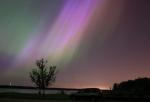 Aurora Iowa
20.05.2005
Early last Sunday morning stars were not the only lights in Iowa skies. The northern lights also shone from the heavens, extending across the midwestern USA and other locations not often graced with auroral displays.
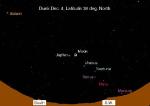 A Sky Full Of Planets
4.12.1997
Look up tonight. Just after sunset, the crescent moon and all five "naked-eye" planets (Mercury, Venus, Mars, Jupiter, and Saturn) will be visible (depending on your latitude), lying near our solar system's ecliptic plane.
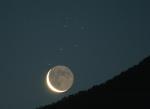 Old Moon and Sister Stars
29.06.2006
An old crescent Moon shares the eastern sky over Menton, France with the sister stars of the Pleiades cluster in this early morning skyscape recorded just last Friday, June 23rd. (Bright Venus was also...
|
January February March April May June July August September October |
|||||||||||||||||||||||||||||||||||||||||||||||||