
|
You entered: Jupiter
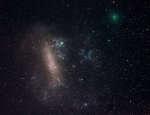 Close Comet and Large Magellanic Cloud
16.03.2016
Sporting a surprisingly bright, lovely green coma Comet 252P/Linear poses next to the Large Magellanic Cloud in this southern skyscape. The stack of telephoto exposures was captured on March 16 from Penwortham, South Australia.
 APOD: 2024 April 29 Б Comet, Planet, Moon
28.04.2024
Three bright objects satisfied seasoned stargazers of the western sky just after sunset earlier this month. The most familiar was the Moon, seen on the upper left in a crescent phase. The rest of the Moon was faintly visible by sunlight first reflected by the Earth.
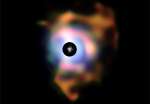 Stardust and Betelgeuse
28.06.2011
An expansive nebula of dust is seen to surround red supergiant star Betegeuse in this remarkable high resolution composite, an infrared VLT image from the European Southern Observatory. Betelgeuse itself is outlined by the small, central red circle. If found in our own solar system its diameter would almost encompass the orbit of Jupiter.
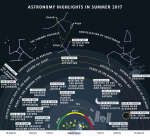 Highlights of the Summer Sky
4.06.2017
What's up in the sky this summer? The featured graphic gives a few highlights for Earth's northern hemisphere. Viewed as a clock face centered at the bottom, early summer sky events fan out toward the left, while late summer events are projected toward the right.
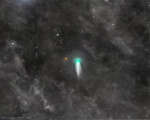 APOD: 2026 August 24 Б Comet 220P in Outburst
23.08.2026
Comet 220P is unexpectedly bright. Normally, periodic Comet 220P/McNaught is so dim that to see it requires a telescope. Two surprising outbursts this year, however, have made it about 20,000 times brighter than usual, so that it is now visible with binoculars and long-duration camera exposures.
 An Inner Neptune for 55 Cancri
1.09.2004
Is our Solar System unique? The discovery of a Neptune-mass planet in an sub-Mercury orbit around nearby Sun-like star 55 Cancri, announced yesterday along with the discovery of other similar systems, gives a new indication that planetary systems as complex as our own Solar System likely exist elsewhere.
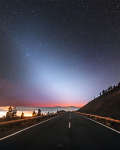 Zodiacal Road
23.07.2019
What's that strange light down the road? Dust orbiting the Sun. At certain times of the year, a band of sun-reflecting dust from the inner Solar System appears prominently just after sunset -- or just before sunrise -- and is called zodiacal light.
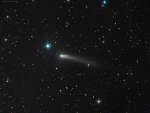 Rosetta's Comet in View
9.09.2021
Faint comet Churyumov-Gerasimenko (67P) sweeps past background stars in the constellation Taurus and even fainter distant galaxies in this telescopic frame from September 7. About 5 years ago, this comet's 4 kilometer spanning...
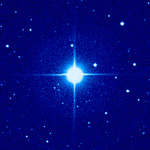 51 Pegasi: A New Planet Discovered
30.11.1995
Are we alone in the universe? Do other stars have planets too? Humanity took one step closer to answering these questions in October 1995 when it was announced that the star 51 Pegasi harbors at least one planet.
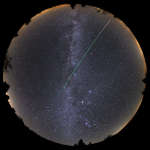 Night of the Long Leonid
22.11.2012
A cosmic grain of sand left the long and colorful trail across this all-sky view. Its grazing impact with planet Earth's atmosphere began at 71 kilometers per second. With the Milky Way stretching...
|
January February March April May June July August September |
|||||||||||||||||||||||||||||||||||||||||||||||||