
|
You entered: star cluster
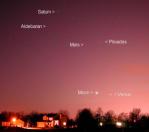 Planets in the West
18.04.2002
Have you seen any bright planets lately? Chances are if you've been outside under clear skies just after sunset, then you have. Now shining in the west as bright "stars" in the night sky, are all five planets of the solar system known to ancient astronomers - Mercury, Venus, Mars, Saturn, and Jupiter.
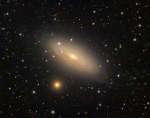 Spiral Galaxy NGC 2841
2.03.2022
A mere 46 million light-years distant, spiral galaxy NGC 2841 can be found in the northern constellation of Ursa Major. This deep view of the gorgeous island universe was captured during 32 clear nights in November, December 2021 and January 2022. It shows off a striking yellow nucleus, galactic disk, and faint outer regions.
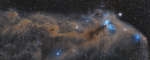 Across Corona Australis
28.11.2018
Cosmic dust clouds are draped across a rich field of stars in this broad telescopic panorama near the northern boundary of Corona Australis, the Southern Crown. Less than 500 light-years away the denser clouds effectively block light from more distant background stars in the Milky Way.
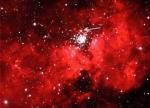 Sher 25: A Pending Supernova
27.10.2001
No supernova has ever been predicted. These dramatic stellar explosions that destroy stars and disperse elements that compose people and planets are not so well understood that astronomers can accurately predict when a star will explode - yet. Perhaps Sher 25 will be the first.
 APOD: 2025 July 8 Б The Pleiades in Red and Blue
7.07.2025
If you have looked at the sky and seen a group of stars about the size of the full Moon, that's the Pleiades (M45). Perhaps the most famous star cluster in the sky, its brightest stars can be seen even from the light-polluted cities.
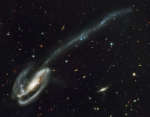 Arp 188 and the Tadpoles Tidal Tail
26.09.2010
Why does this galaxy have such a long tail? In this stunning vista recorded with the Hubble Space Telescope's Advanced Camera for Surveys, distant galaxies form a dramatic backdrop for disrupted spiral galaxy Arp 188, the Tadpole Galaxy. The cosmic tadpole is a mere 420 million light-years distant toward the northern constellation Draco.
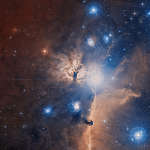 Inside the Flame Nebula
10.05.2014
The Flame Nebula stands out in this optical image of the dusty, crowded star forming regions toward Orion's belt, a mere 1,400 light-years away. X-ray data from the Chandra Observatory and infrared images from the Spitzer Space Telescope can take you inside the glowing gas and obscuring dust clouds though.
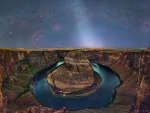 A Zodiacal Sky over Horseshoe Bend
21.05.2017
What's causing the unusual ray of white light extending upward from the central horizon? Dust orbiting the Sun. At certain times of the year, a band of sun-reflecting dust from the inner Solar System rises prominently before sunrise and is called zodiacal light.
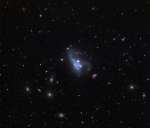 NGC 3239 and SN 2012A
27.01.2012
About 40,000 light-years across, pretty, irregular galaxy NGC 3239 lies near the center of this lovely field of galaxies in the galaxy rich constellation Leo. At a distance of only 25 million light-years...
 NGC 602 and Beyond
23.03.2018
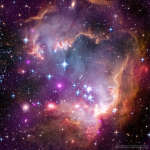
Near the outskirts of the Small Magellanic Cloud, a satellite galaxy some 200 thousand light-years distant, lies 5 million year young star cluster NGC 602. Surrounded by natal gas and dust...
|
January February March April May |
|||||||||||||||||||||||||||||||||||||||||||||||||