
|
You entered: young stars
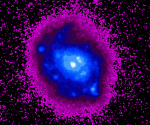 M77: Spiral with a Strange Glow
10.09.1996
Why is M77 surrounded by an ultraviolet glow? M77, also called NGC 1068, appears at first sight to be a relatively normal barred spiral galaxy. But when photographed in the ultraviolet (UV), as shown above in false color, the galaxy sports an ultraviolet halo - shown as violet in the photograph.
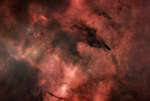 APOD: 2026 May 20 Б The Dark Wolf Nebula
20.05.2026
A dark wolf lies in gum. No, this isnБt a riddle! Today's image features the Dark Wolf Nebula (SandqvistБLindroos 17), a spooky dust cloud embedded within the Gum 55 (RCW 113) Nebula in the Scorpius constellation.
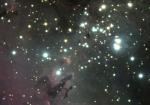 Blue Stars and Red Pillars
18.07.1997
Bright blue stars are still forming in the red pillars of the Eagle Nebula. Made famous by a picture from the Hubble Space Telescope in 1995, the Eagle Nebula shows the dramatic process of star formation. To the upper right of the nebula in the above picture lies the heart of the open cluster M16.
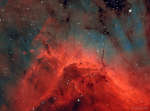 Pillars and Jets in the Pelican Nebula
3.03.2015
What dark structures arise from the Pelican Nebula? Visible as a bird-shaped nebula toward the constellation of a bird (Cygnus, the Swan), the Pelican Nebula is a place dotted with newly formed stars but fouled with dark dust.
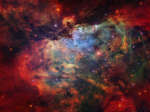 APOD: 2026 June 10 Б The Eagle Nebula and Friends
10.06.2026
What looks as if it is going to swallow the great Pillars of Creation? The Eagle Nebula (M16) is not a bird, a plane, or Superman. M16 is actually a combination of several celestial objects. NGC 6611 is the young star cluster that appears to peak out beneath the EagleБs БwingsБ.
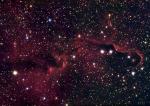 The Elephant s Trunk in IC 1396
20.07.2001
Like a picture from a galactic Just So Story, the Elephant's Trunk Nebula winds through the emission nebula and young star cluster complex IC 1396, in the high and far off constellation of Cepheus. Bright swept-back ridges compose the suggestive form, outlining pockets of interstellar dust and gas.
 The Deep Lagoon
28.09.2023
Ridges of glowing interstellar gas and dark dust clouds inhabit the turbulent, cosmic depths of the Lagoon Nebula. Also known as M8, The bright star forming region is about 5,000 light-years distant. It makes for a popular stop on telescopic tours of the constellation Sagittarius toward the center of our Milky Way Galaxy.
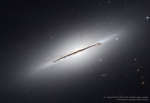 Edge On Galaxy NGC 5866
9.03.2016
Why is this galaxy so thin? Many disk galaxies are actually just as thin as NGC 5866, pictured above, but are not seen edge-on from our vantage point. One galaxy that is situated edge-on is our own Milky Way Galaxy.
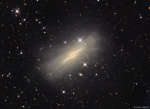 The Edge On Spindle Galaxy
25.07.2018
What kind of celestial object is this? A relatively normal galaxy -- but seen from its edge. Many disk galaxies are actually just as thin as NGC 5866, pictured here, but are not seen edge-on from our vantage point. A perhaps more familiar galaxy seen edge-on is our own Milky Way Galaxy.
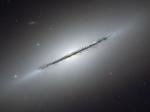 Edge On Galaxy NGC 5866
12.06.2006
Why is this galaxy so thin? Many disk galaxies are actually just as thin as NGC 5866, pictured above, but are not seen edge-on from our vantage point. One galaxy that is situated edge-on is our own Milky Way Galaxy.
|
January February March April May June July August September |
|||||||||||||||||||||||||||||||||||||||||||||||||