
|
You entered: ring galaxy
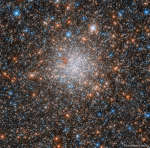 APOD: 2025 December 28 Б NGC 1898: Globular Cluster in the Large Magellanic Cloud
28.12.2025
Jewels don't shine this bright -- only stars do. And almost every spot in this jewel-box of an image from the Hubble Space Telescope is a star. Now, some stars are more red than our Sun, and some more blue -- but all of them are much farther away.
 Hydrogen Clouds of M33
30.01.2025
Gorgeous spiral galaxy Messier 33 seems to have more than its fair share of glowing hydrogen gas. A prominent member of the local group of galaxies, M33 is also known as the Triangulum Galaxy and lies a mere 3 million light-years away.
 Hydrogen Clouds of M33
13.10.2023
Gorgeous spiral galaxy Messier 33 seems to have more than its fair share of glowing hydrogen gas. A prominent member of the local group of galaxies, M33 is also known as the Triangulum Galaxy and lies a mere 3 million light-years away.
 Methane Dwarf
3.06.1999
While hunting through Sloan Sky Survey data in search of distant quasars, Princeton astronomers Xiaohui Fan and Michael Strauss came upon an undiscovered type of object very nearby - now dubbed a methane dwarf. Marked...
 The Heart and Soul Nebulas
15.01.2019
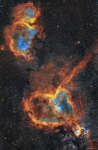
Is the heart and soul of our Galaxy located in Cassiopeia? Possibly not, but that is where two bright emission nebulas nicknamed Heart and Soul can be found. The Heart Nebula, officially dubbed IC 1805 and visible in the featured image on the bottom right, has a shape reminiscent of a classical heart symbol.
 Hydrogen in M51
11.06.2010
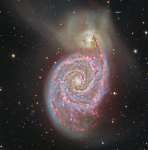
Perhaps the original spiral nebula, M51 is a large galaxy, over 60,000 light-years across, with a readily apparent spiral structure. Also cataloged as NGC 5194, M51 is a part of a well-known interacting galaxy pair, its spiral arms and dust lanes clearly sweeping in front of companion galaxy NGC 5195 (top).
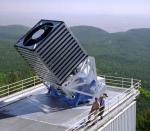 The Sloan Digital Sky Survey Telescope
17.06.1998
The Sloan Digital Sky Survey (SDSS) will soon begin. Pictured above is the 2.5-meter telescope poised to create the most ambitious sky map in the history of astronomy. SDSS will catalog one quarter of the sky down past 23rd magnitude ( R), obtaining redshifts for galaxies and quasars brighter than magnitude 19.
 Globular Star Cluster 47 Tuc
16.01.2011
Globular star cluster 47 Tucanae is a jewel of the southern sky. Also known as NGC 104, it roams the halo of our Milky Way Galaxy along with some 200 other globular star clusters.
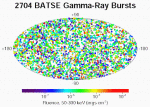 BATSE GRB Final Sky Map
28.06.2000
What causes the most powerful explosions in the universe? The BATSE modules that flew on the Compton Gamma Ray Observatory allowed more insight into enigmatic gamma-ray burst (GRB) explosions than ever before. From 1991-2000, BATSE detected 2704 GRBs, much more than ever previously recorded.
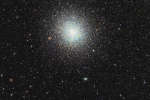 47 Tuc: A Great Globular Cluster of Stars
26.08.2008
Stars come in bunches. Of the over 200 globular star clusters that orbit the center of our Milky Way Galaxy, 47 Tucanae is the second brightest globular cluster (behind Omega Centauri). Light takes about...
|
January February March April May June July August September |
|||||||||||||||||||||||||||||||||||||||||||||||||