
|
You entered: full moon
 Sharpless 308: The Dolphin Head Nebula
7.06.2024
Blown by fast winds from a hot, massive star, this cosmic bubble is huge. Cataloged as Sharpless 2-308 it lies some 5,000 light-years away toward the well-trained constellation Canis Major and covers slightly more of the sky than a Full Moon. That corresponds to a diameter of 60 light-years at its estimated distance.
 Introducing Comet ISON
1.10.2012
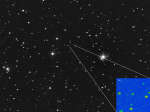
Could this dim spot brighten into one of the brightest comets ever? It's possible. Alternatively, the comet could break up when it gets closer to the Sun, or brighten much more modestly.
 A Beautiful Trifid
5.08.2022
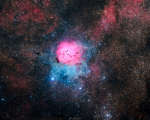
The beautiful Trifid Nebula is a cosmic study in contrasts. Also known as M20, it lies about 5,000 light-years away toward the nebula rich constellation Sagittarius. A star forming region in the plane...
 Mercury and Crescent Moon Set
15.04.2016
Innermost planet Mercury and a thin crescent Moon are never found far from the Sun in planet Earth's skies. Taken near dusk on April 8, this colorful evening skyscape shows them both setting toward the western horizon just after the Sun.
 A Fox Fur, a Unicorn, and a Christmas Tree
10.04.2012
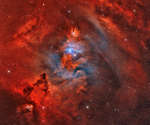
What do the following things have in common: a cone, the fur of a fox, and a Christmas tree? Answer: they all occur in the constellation of the unicorn (Monoceros). Pictured above...
 A Fox Fur, a Unicorn, and a Christmas Tree
4.01.2015
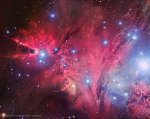
What do the following things have in common: a cone, the fur of a fox, and a Christmas tree? Answer: they all occur in the constellation of the unicorn (Monoceros). Pictured as a star...
 Three Galaxies in Draco
1.07.2023
This tantalizing trio of galaxies sometimes called the Draco Group, is located in the northern constellation of (you guessed it) Draco, the Dragon. From left to right are face-on spiral NGC 5985, elliptical galaxy...
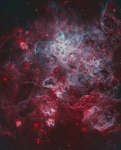 The Tarantula Zone
13.11.2020
The Tarantula Nebula, also known as 30 Doradus, is more than a thousand light-years in diameter, a giant star forming region within nearby satellite galaxy the Large Magellanic Cloud. About 180 thousand light-years away, it's the largest, most violent star forming region known in the whole Local Group of galaxies.
 APOD: 2023 November 21 Б Flemings Triangular Wisp
21.11.2023
These chaotic and tangled filaments of shocked, glowing gas are spread across planet Earth's sky toward the constellation of Cygnus as part of the Veil Nebula. The Veil Nebula itself is a large supernova remnant, an expanding cloud born of the death explosion of a massive star.
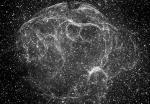 Simeis 147: Supernova Remnant
30.08.2002
It's easy to get lost following the intricate filaments in this stunningly detailed image of faint supernova remnant Simeis 147. Seen towards the constellation Taurus it covers nearly 3 degrees (6 full moons)...
|
January February March April May June July August |
||||||||||||||||||||||||||||||||||||||||||||||||||||||||