
|
You entered: Observatory
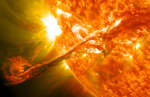 A Solar Filament Erupts
17.09.2012
What's happened to our Sun? Nothing very unusual -- it just threw a filament. At the end of last month, a long standing solar filament suddenly erupted into space producing an energetic Coronal Mass Ejection (CME).
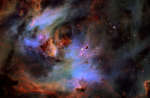 Globules in the Running Chicken Nebula
5.03.2014
The eggs from this chicken may form into stars. The above pictured emission nebula, cataloged as IC 2944, is called the Running Chicken Nebula for the shape of its greater appearance. The image was taken recently from Siding Spring Observatory in Australia and presented in scientifically assigned colors.
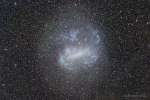 APOD: 2023 March 7 Б Deep Field: The Large Magellanic Cloud
7.03.2023
Is this a spiral galaxy? No. Actually, it is the Large Magellanic Cloud (LMC), the largest satellite galaxy of our own Milky Way Galaxy. The LMC is classified as a dwarf irregular galaxy because of its normally chaotic appearance. In this deep and wide exposure, however, the full extent of the LMC becomes visible.
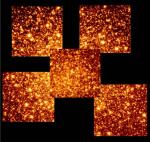 NGC 6712: Galactic Globular Cluster
25.02.1999
Following orbits which loop high above the galactic plane, globular star clusters are probably 12 to 14 billion years old - truly ancient denizens of our Milky Way Galaxy. After analyzing these new ESO/VLT images...
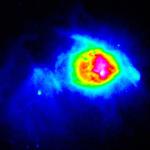 Hydrogen Blob N88A in the Small Magellanic Cloud
29.07.1999
The bright blob of hydrogen gas cataloged as N88A is seen at the right. It measures a mere 3 light years across. Emerging from the cool, dusty interstellar medium in a nearby irregular galaxy known as the Small Magellanic Cloud, N88A hides hot young stars at its core.
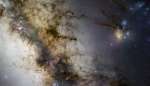 Gigagalaxy Zoom: Galactic Center
25.09.2009
From Sagittarius to Scorpius, the central Milky Way is a truly beautiful part of planet Earth's night sky. The gorgeous region is captured here, an expansive gigapixel mosaic of 52 fields spanning 34 by 20 degrees in 1200 individual images and 200 hours of exposure time.
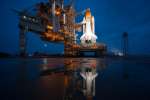 Atlantis Reflection
9.07.2011
Space shuttle orbiter Atlantis left planet Earth on Friday, July 8, embarking on the STS-135 mission to the International Space Station. The momentous launch was the final one in NASA's 30 year space shuttle program that began with the launch of the first reusable spacecraft on April 12, 1981.
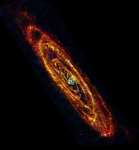 Herschel s Andromeda
2.02.2013
This infrared view from the Herschel Space Observatory explores the Andromeda Galaxy, the closest large spiral galaxy to our own Milky Way. Only 2.5 million light-years distant, the famous island universe is also known to astronomers as M31. Andromeda spans over 200,000 light-years making it more the twice the size of the Milky Way.
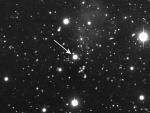 QSO H1821 643 Indicates a Universe Filled with Hydrogen
16.05.2000
A quasar slightly depleted of a specific color of light may indicate that our universe is filled with massive amounts of ionized hydrogen. Light from QSO H1821+643, pictured above, comes to us from about a quarter of the way across the visible universe.
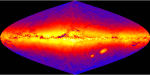 USNO A2.0 Catalog: A Digital Sky
26.04.1999
Here lie 526,230,881 of the brightest stars known. The US Naval Observatory has deployed their monster Precision Measuring Machine to digitize photographic plates covering the whole sky and creating the above map. Yellow corresponds to 150,000 stars per square degree, while dark blue corresponds to only 500 stars per square degree.
|
January February March April May June July August September October |
|||||||||||||||||||||||||||||||||||||||||||||||||