
|
You entered: massive stars
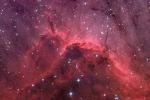 IC 5067: Emission Nebula Close up
27.12.2006
This amazing skyscape lies along a bright ridge of emission in IC 5067, also known as The Pelican Nebula. Appropriately, the Pelican Nebula itself is part of a much larger, complex star-forming region about 2,000 light-years away in the high flying constellation Cygnus, the Swan.
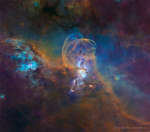 Star Forming Region NGC 3582 without Stars
20.09.2022
What's happening in the Statue of Liberty nebula? Bright stars and interesting molecules are forming and being liberated. The complex nebula resides in the star forming region called RCW 57, and besides the iconic monument, to some looks like a flying superhero or a weeping angel.
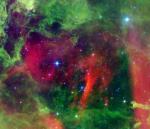 Hot Stars in the Rosette Nebula
26.07.2007
Winds and radiation from massive hot stars in the Rosette Nebula have cleared the natal gas and dust from the center of the nearby star-forming region. They also pose a danger to planet forming disks around young, cooler stars in the neighborhood.
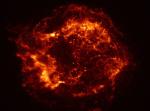 Chandras First Light: Cassiopeia A
27.08.1999
Cosmic wreckage from the detonation of a massive star is the subject of this official first image from NASA's Chandra X-ray Observatory. The supernova remnant, known as Cassiopeia A, was produced when a star exploded around 300 years ago in this northern sky constellation.
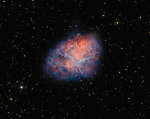 M1: The Crab Nebula
20.11.2014
The Crab Nebula is cataloged as M1, the first object on Charles Messier's famous 18th century list of things which are not comets. In fact, the Crab is now known to be a supernova remnant, debris from the death explosion of a massive star, witnessed by astronomers in the year 1054.
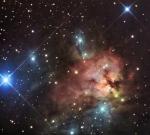 NGC 1579: Trifid of the North
25.05.2006
Colorful NGC 1579 resembles the better known Trifid Nebula, but lies much farther north in planet Earth's sky, in the heroic constellation Perseus. About 2,100 light-years away and 3 light-years across, NGC 1579 is a captivating study in color.
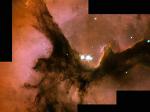 The Trifid Nebula from Hubble
18.06.2004
Clouds of glowing gas mingle with lanes of dark dust in the Trifid Nebula, a star forming region toward the constellation of Sagittarius. In the center, the three huge dark dust lanes that give the Trifid its name all come together.
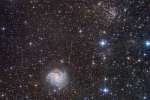 Star Cluster, Spiral Galaxy, Supernova
25.05.2017
A cosmic snapshot from May 19, this colorful telescopic field of view spans about 1 degree or 2 full moons on the sky. Spiky in appearance, foreground Milky Way stars are scattered toward...
 72.6: Oxygen Supply
28.05.2003
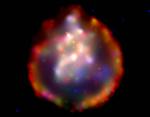
A supernova explosion, a massive star's inevitable and spectacular demise, blasts back into space debris enriched in the heavy elements forged in its stellar core. Incorporated into future stars and planets, these are the elements ultimately necessary for life.
 The Tarantula Nebula from SuperBIT
27.04.2023
The Tarantula Nebula, also known as 30 Doradus, is more than a thousand light-years in diameter, a giant star forming region within nearby satellite galaxy the Large Magellanic Cloud. About 160 thousand light-years away, it's the largest, most violent star forming region known in the whole Local Group of galaxies.
|
January February |
|||||||||||||||||||||||||||||||||||||||||||||||||