
|
You entered: emission
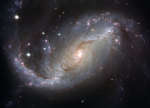 Spiral Galaxy NGC 1672 from Hubble
13.05.2012
Many spiral galaxies have bars across their centers. Even our own Milky Way Galaxy is thought to have a modest central bar. Prominently barred spiral galaxy NGC 1672, pictured above, was captured in spectacular detail in image taken by the orbiting Hubble Space Telescope.
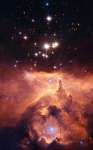 NGC 6357s Cathedral to Massive Stars
18.11.2012
How massive can a normal star be? Estimates made from distance, brightness and standard solar models had given one star in the open cluster Pismis 24 over 200 times the mass of our Sun, nearly making it the record holder.
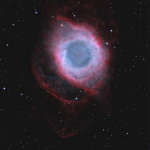 NGC 7293: The Helix Nebula
10.01.2014
A mere seven hundred light years from Earth, in the constellation Aquarius, a sun-like star is dying. Its last few thousand years have produced the Helix Nebula (NGC 7293), a well studied and nearby example of a Planetary Nebula, typical of this final phase of stellar evolution.
 Portrait of NGC 281
27.11.2014
Look through the cosmic cloud cataloged as NGC 281 and you might miss the stars of open cluster IC 1590. But, formed within the nebula, that cluster's young, massive stars ultimately power the pervasive nebular glow.
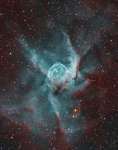 NGC 2359: Thor s Helmet
16.02.2019
NGC 2359 is a helmet-shaped cosmic cloud with wing-like appendages popularly called Thor's Helmet. Heroically sized even for a Norse god, Thor's Helmet is about 30 light-years across. In fact, the helmet...
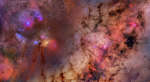 Scorpius Enhanced
16.06.2021
If Scorpius looked this good to the unaided eye, humans might remember it better. Scorpius more typically appears as a few bright stars in a well-known but rarely pointed out zodiacal constellation. To get a spectacular image like this, though, one needs a good camera, a dark sky, and some sophisticated image processing.
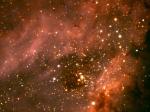 Composing the Omega Nebula
11.12.2000
The Omega Nebula is a massive, complex cloud of dust and gas from which new stars are continually forming. The similarity to the Greek letter capital Omega gives the molecular cloud its popular name, but the nebula is also known as the Swan Nebula, the Horseshoe Nebula, and M17.
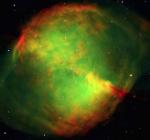 M27: Not A Comet
2.03.2002
While searching the skies above 18th century France for comets, astronomer Charles Messier diligently recorded this object as number 27 on his list of things which are definitely not comets. So what is it?
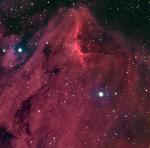 The Pelican in the Swan
29.08.2002
The Pelican Nebula, also known as IC 5070, lies about 2,000 light-years away in the high and far-off constellation of Cygnus, the Swan. This picture spans a portion of the magnificent nebula about 30 light-years wide.
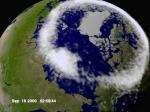 A Proton Aurora
17.12.2003
What are auroras made out of? Most auroras are caused by the solar wind exciting electrons that are funneled down the Earth's magnetic field. These electrons strike air molecules, liberating other electrons that glow when re-acquired.
|
January February March April May June July August |
||||||||||||||||||||||||||||||||||||||||||||||||||||||||