
|
You entered: time
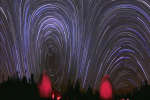 Warped Sky: Star Trails Panorama
11.07.2010
What's happened to the sky? A time warp, of sorts, and a digital space warp too. The time warp occurs because this image captured in a single frame a four hour exposure of the night sky. As a result, prominent star trails are visible.
 Shocked by Supernova 1987A
27.02.2012
Twenty five years ago, the brightest supernova of modern times was sighted. Over time, astronomers have watched and waited for the expanding debris from this tremendous stellar explosion to crash into previously expelled material.
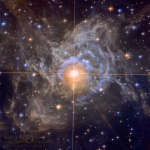 RS Puppis
17.05.2019
Pulsating RS Puppis, the brightest star in the image center, is some ten times more massive than our Sun and on average 15,000 times more luminous. In fact, RS Pup is a Cepheid...
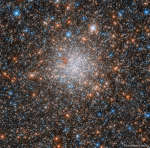 APOD: 2025 December 28 Б NGC 1898: Globular Cluster in the Large Magellanic Cloud
28.12.2025
Jewels don't shine this bright -- only stars do. And almost every spot in this jewel-box of an image from the Hubble Space Telescope is a star. Now, some stars are more red than our Sun, and some more blue -- but all of them are much farther away.
 An Unusual Venusian Oval
13.02.2012
Why would Venus appear oval? Venus has been seen countless times from the surface of the Earth, and every time the Earth's atmosphere has dispersed its light to some degree. When...
 Flashes of the Crab Pulsar
9.02.2021
It somehow survived an explosion that would surely have destroyed our Sun. Now it is spins 30 times a second and is famous for the its rapid flashes. It is the Crab Pulsar, the rotating neutron star remnant of the supernova that created the Crab Nebula.
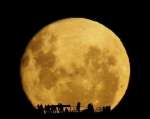 Full Moon Silhouettes
3.12.2017
Have you ever watched the Moon rise? The slow rise of a nearly full moon over a clear horizon can be an impressive sight. One impressive moonrise was imaged in early 2013 over Mount Victoria Lookout in Wellington, New Zealand.
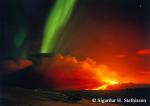 Volcano and Aurora in Iceland
21.01.2002
Sometimes both heaven and Earth erupt. In Iceland in 1991, the volcano Hekla erupted at the same time that auroras were visible overhead. Hekla, one of the most famous volcanoes in the world, has erupted at least 20 times over the past millennium, sometimes causing great destruction.
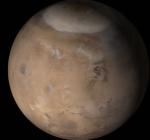 Springtime on Mars
22.04.2003
Vast canyons, towering volcanoes, sprawling fields of ice, deep craters, and high clouds can all be seen in this image of the Solar System's fourth planet: Mars. The orbiting robot Mars Global Surveyor spacecraft took the above mosaic of images as springtime dawned in Northern Mars in 2002 May.
 A Powerful Solar Flare
29.10.2003
Yesterday, our Sun produced one of the most powerful solar flares in recorded history. Seen across the electromagnetic spectrum, the Sun briefly became over 100 times brighter in X-rays than normal. Over the next few days, as energetic particles emitted from these regions strike the Earth, satellite communications might be affected and auroras might develop.
|
January February March April May June July August September |
|||||||||||||||||||||||||||||||||||||||||||||||||