
|
You entered: red spot
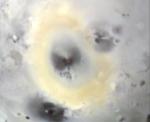 Io Volcano: Pele's Hot Lava
26.11.1999
Glowing hot lava from the heart of Io's volcano Pele is visible in this false-color infrared composite image. It was recorded last month during the Galileo spacecraft's close flyby of the Jovian moon.
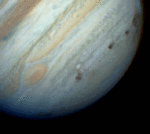 Comet Impacts on Jupiter
14.07.1995
In July of 1994, pieces of Comet Shoemaker-Levy 9, also known as the "string of pearls" comet, collided with the planet Jupiter. As the comet fragments smashed in to Jupiter, the resulting explosions scattered large quantities of dusty cometary debris into the Jovian atmosphere.
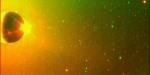 Io's Sodium Cloud
28.04.1997
Io has its own cloud. Jupiter's most active moon is visible on the left of the above false-color photograph, with its left side illuminated by sunlight. But what is happening on Io's right side? Here a plume of gas from the active volcano Prometheus also reflects sunlight.
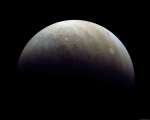 Southern Jupiter from Perijove 3
17.12.2016
Southern Jupiter looms some 37,000 kilometers away in this JunoCam image from December 11. The image data was captured near Juno's third perijove or closest approach to Jupiter, the spacecraft still in its 53 day long looping orbit.
 Jupiter s Swimming Storm
10.09.2020
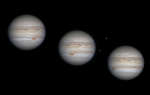
A bright storm head with a long turbulent wake swims across Jupiter in these sharp telescopic images of the Solar System's ruling gas giant. Captured on August 26, 28, and September 1 (left to right) the storm approximately doubles in length during that period.
 Storm Clouds Over Jupiter
27.11.1996
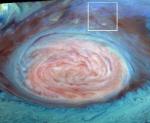
Storm clouds, similar to the familiar cumulonimbus thunderheads of Earth, appear to be present on Jupiter. The mosaic of images above shows the region near the raging edge of Jupiter's Great Red Spot, itself some 2 to 3 Earths wide, as observed by the Galileo spacecraft in June of this year.
 Jupiter, Europa, and Callisto
2.01.2001
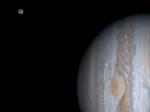
As the robot Cassini spacecraft rounds Jupiter on its way toward Saturn, it has taken a sequence of images of the gas giant with its four largest moons. Previously released images have highlighted Ganymede and Io. Pictured above are the two remaining Galilean satellites: Europa and Callisto.
 Jupiter and Io
28.11.2012
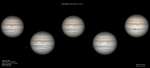
On December 3 (UT), Jupiter, the solar system's largest planet, will be at opposition, opposite the Sun in planet Earth's sky, shining brightly and rising as the Sun sets. That configuration results in Jupiter's almost annual closest approach to planet Earth.
 Stereo Jupiter near Opposition
24.11.2023
Jupiter looks sharp in these two rooftop telescope images. Both were captured on November 17 from Singapore, planet Earth, about two weeks after Jupiter's 2023 opposition. Climbing high in midnight skies the giant planet was a mere 33.4 light-minutes from Singapore. That's about 4 astronomical units away.
 Jupiter from Voyager
25.06.1995
Imagine a hurricane that lasted for 300 years! This picture of the planet Jupiter was taken by the Voyager 1 spacecraft as it passed the planet in 1979. Jupiter, a gas giant planet with no solid surface, is the largest planet in the solar system and is made mostly of the hydrogen and helium.
|
January February March April May June July August September |
|||||||||||||||||||||||||||||||||||||||||||||||||