
|
You entered: red/blue glasses
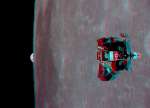 The Eagle Rises
21.07.2012
Get out your red/blue glasses and check out this remarkable stereo view from lunar orbit. Created from two photographs (AS11-44-6633, AS11-44-6634) taken by astronaut Michael Collins during the 1969 Apollo 11 mission...
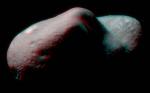 Stereo Eros
24.02.2000
Get out your red/blue glasses and float next to asteroid 433 Eros, 260 million kilometers away! Orbiting the Sun once every 1.8 earth-years, asteroid Eros is a diminutive 40 x 14 x 14 kilometer world of undulating horizons, craters, boulders and valleys.
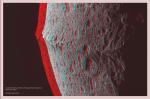 Iapetus: 3D Equatorial Ridge
15.09.2007
This bizarre, equatorial ridge extending across and beyond the dark, leading hemisphere of Iapetus gives the two-toned Saturnian moon a distinct walnut shape. With red/blue glasses you can check out a remarkable stereo composition of this extraordinary feature -- based on close-up images from this week's Cassini spacecraft flyby.
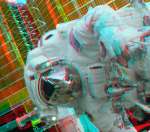 Take My Hand
18.09.2009
Get out your red/blue glasses and check out this close-up of spacesuited NASA astronaut John Olivas outside the International Space Station. Carefully constructed from two photographs (ISS020-E-038481, ISS02-0E-038482) taken during space shuttle orbiter Discovery...
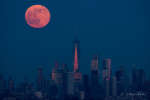 Manhattan Moonrise
16.06.2017
A Full Moon rose as the Sun set on June 9, known to some as a Strawberry Moon. Close to the horizon and taking on the warm color of reflected sunlight filtered through...
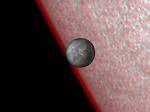 3D Mercury Transit
25.11.2006
Mercury is now visible shortly before dawn, the brightest "star" just above the eastern horizon. But almost two weeks ago Mercury actually crossed the face of the Sun for the second time in the 21st century.
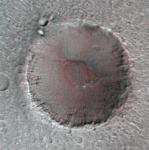 Mars: Big Crater in Stereo
30.04.1998
Get out your red/blue glasses and check out this stereo picture of "Big Crater" on Mars! (Pieces of red and blue or green clear plastic will do. Your right eye should look through...
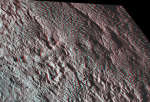 Pluto s Bladed Terrain in 3D
2.04.2016
Get out your red/blue glasses and gaze across a mountainous region informally known as Tartarus Dorsa. This scene sprawls some 300 kilometers (about 180 miles) across the Plutonian landscape. The color anaglyph creates...
 Stereo Helene
1.06.2024
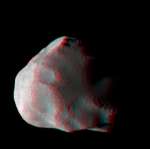
Get out your red/blue glasses and float next to Helene, small, icy moon of Saturn. Appropriately named, Helene is a Trojan moon, so called because it orbits at a Lagrange point. A Lagrange point is a gravitationally stable position near two massive bodies, in this case Saturn and larger moon Dione.
 Stereo Helene
29.03.2025
Get out your red/blue glasses and float next to Helene, small, icy moon of Saturn. Appropriately named, Helene is a Trojan moon, so called because it orbits at a Lagrange point. A Lagrange point is a gravitationally stable position near two massive bodies, in this case Saturn and larger moon Dione.
|
January February March April May June July August September October |
|||||||||||||||||||||||||||||||||||||||||||||||||