
|
You entered: plasma
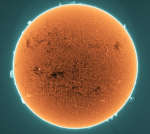 Prominences and Filaments on the Active Sun
14.06.2024
This colorized and sharpened image of the Sun is composed of frames recording emission from hydrogen atoms in the solar chromosphere on May 15. Approaching the maximum of solar cycle 25, a multitude of active regions and twisting, snake-like solar filaments are seen to sprawl across the surface of the active Sun.
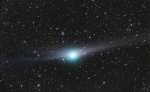 Another Tail for Comet Garradd
3.03.2012
Remarkable comet Garradd (C2009/P1) has come to be known for two distinctive tails. From the perspective of earthbound comet watchers the tails are visible on opposite sides of its greenish coma. Seen here in a telescopic view, the recognizable dust tail fans out to the right, trailing the comet nucleus in its orbit.
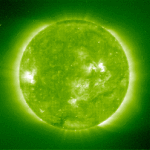 Sun and Winter Solstice 1996
20.12.1996
Today is the Winter Solstice for 1996. After steadily sinking in Northern Hemisphere skies, the Sun is now at its lowest declination - marking the first day of Northern Winter (but Southern Summer!). The Earth...
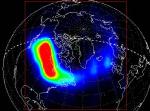 Solar Storm Causes X-Ray Aurora
18.04.1997
On April 7, the SOHO spacecraft spotted a Solar Storm ejecting a cloud of energetic particles toward planet Earth. The plasma cloud's center missed Earth, but high energy particles swept up by Earth's magnetosphere still created a geomagnetic storm!
 Rivers in the Sun
4.09.1997
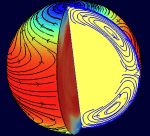
The surface of the Sun is shifting. By watching sunspots, it has long been known that our Sun rotates. It was also known that the center of the Sun rotates faster than the poles.
 Dark Ball in Inverted Starfield
5.11.2022
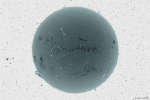
Does this strange dark ball look somehow familiar? If so, that might be because it is our Sun. In the featured image from 2012, a detailed solar view was captured originally in a very specific color of red light, then rendered in black and white, and then color inverted.
 30 Doradus Across the Spectrum
23.12.1997
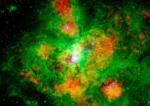
30 Doradus is lit up like a Christmas tree. Shining in light across the electromagnetic spectrum, 30 Doradus glows because of all the energetic processes that go on there. A distinctive region visible...
 Earth's Plasmasphere
30.01.2001
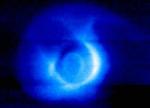
Our Earth is surrounded by plasma. The overall shape that this ionized gas plasmasphere takes was discovered last year by NASA's robot IMAGE spacecraft, and shown in the recently released above image in ultraviolet light.
 Black Sun and Inverted Starfield
15.10.2012
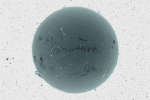
Does this strange dark ball look somehow familiar? If so, that might be because it is our Sun. In the above image, a detailed solar view was captured originally in a very specific color of red light, then rendered in black and white, and then color inverted.
 Mercury And The Sun
18.11.1999
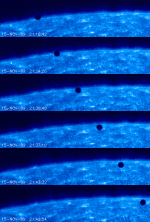
Just days before the peak of the Leonid meteor shower, skywatchers were offered another astronomical treat as planet Mercury crossed the face of the Sun on November 15. Viewed from planet Earth, a transit of Mercury is not all that rare. The last occurred in 1993 and the next will happen in 2003.
|
January February March April May June July August September |
|||||||||||||||||||||||||||||||||||||||||||||||||