
|
You entered: meteor shower
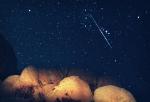 Bright Meteor, Dark Sky
20.08.1997
Has Orion the Hunter acquired a new weapon? If you turn your head sideways (counterclockwise) you might notice the familiar constellation of Orion, particularly the three consecutive bright stars that make up Orion's belt.
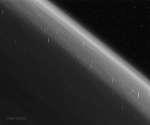 Tau Herculids from Space
4.06.2022
On May 31 tens of parallel meteor streaks were recorded in this 8 degree wide field of view of planet Earth's limb from space. The image is one of a series of 5 minute long observations by the orbiting Yangwang-1 space telescope.
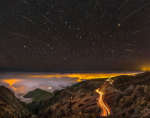 Meteors, Comet, and Big Dipper over La Palma
23.04.2019
Meteor showers are caused by streams of solid particles, dust size and larger, moving as a group through space. In most cases, the orbits of these meteor streams can be identified with dust expelled from a comet.
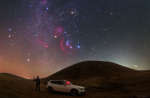 Orionid Meteors from Orion
30.10.2017
Meteors have been shooting out from the constellation of Orion. This was expected, as October is the time of year for the Orionids Meteor Shower. Pictured here, over a dozen meteors were caught in successively added exposures last weekend over Wulan Hada volcano in Inner Mongolia, China.
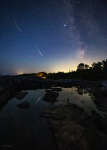 APOD: 2026 August 15 Б Bright Perseids from Sweden
15.08.2026
Known for its bright and fast meteors, the annual Perseid Meteor Shower comes to planet Earth's skies from a radiant in the heroic constellation Perseus. The popular northern summer celestial spectacle is created...
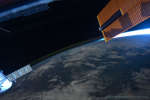 A Perseid Below
8.08.2021
Earthlings typically watch meteor showers by looking up. But this remarkable view, captured on August 13, 2011 by astronaut Ron Garan, caught a Perseid meteor by looking down. From Garan's perspective onboard...
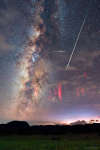 Perseid Meteor, Red Sprites, and Nova RS Oph
16.08.2021
This was an unusual sky. It wasn't unusual because of the central band the Milky Way Galaxy, visible along the image left. Most dark skies show part of the Milky Way. It wasn't unusual because of the bright meteor visible on the upper right.
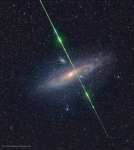 Meteor before Galaxy
12.08.2018
What's that green streak in front of the Andromeda galaxy? A meteor. While photographing the Andromeda galaxy in 2016, near the peak of the Perseid Meteor Shower, a sand-sized rock from deep space crossed right in front of our Milky Way Galaxy's far-distant companion.
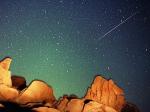 A Perseid Meteor
11.08.2004
The ongoing Perseid Meteor Shower should be at its strongest tonight and tomorrow night. Although meteors should be visible all night long, the best time to watch will be between 2:00 AM and dawn each night. In dark, moonless, predawn skies you may see dozens of meteors per hour.
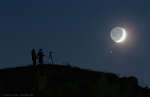 The Hill, The Moon, and Saturn
16.11.2018
Last Sunday when the Moon was young its sunlit crescent hung low near the western horizon at sunset. With strong earthshine it was joined by Saturn shining in the early evening sky for a beautiful conjunction visible to skygazers around our fair planet.
|
January February March April May June July August September October |
|||||||||||||||||||||||||||||||||||||||||||||||||