
|
You entered: galactic plane
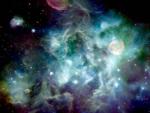 A Radio Vista of Cygnus
18.02.2002
Shells of ancient supernovas, cocoons surrounding newborn stars, and specks from distant quasars highlight this tremendous vista toward the constellation of Cygnus. The representative color image covers about 10 degrees across on the sky but is only a small part of the Canadian Galactic Plane Survey in radio light.
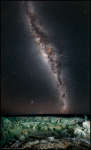 Southern Craters and Galaxies
26.12.2015
The Henbury craters in the Northern Territory, Australia, planet Earth, are the scars of an impact over 4,000 years old. When an ancient meteorite fragmented into dozens of pieces, the largest made the 180 meter diameter crater whose weathered walls and floor are lit in the foreground of this southern hemisphere nightscape.
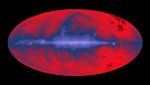 The Radio Sky: Tuned to 408MHz
26.11.1996
Tune your radio telescope to 408MHz (408 million cycles per second) and check out the Radio Sky! You should find that frequency on your dial somewhere between US broadcast television channels 13 and 14.
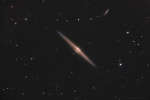 NGC 4565: Galaxy on Edge
22.02.2019
Magnificent spiral galaxy NGC 4565 is viewed edge-on from planet Earth. Also known as the Needle Galaxy for its narrow profile, bright NGC 4565 is a stop on many telescopic tours of the northern sky, in the faint but well-groomed constellation Coma Berenices.
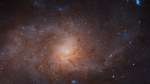 The Stars of the Triangulum Galaxy
23.02.2019
Like grains of sand on a cosmic beach, stars of the Triangulum Galaxy are resolved in this sharp mosaic from the Hubble Space Telescope's Advanced Camera for Surveys (ACS). The inner region of the galaxy spanning over 17,000 light-years is covered at extreme resolution, the second largest image ever released by Hubble.
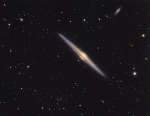 NGC 4565: Galaxy on Edge
4.03.2010
Magnificent spiral galaxy NGC 4565 is viewed edge-on from planet Earth. Also known as the Needle Galaxy for its narrow profile, bright NGC 4565 is a stop on many telescopic tours of the northern sky, in the faint but well-groomed constellation Coma Berenices.
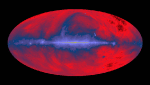 The Radio Sky: Tuned to 408MHz
14.12.1997
Tune your radio telescope to 408MHz (408 million cycles per second) and check out the Radio Sky! You should find that frequency on your dial somewhere between US broadcast television channels 13 and 14.
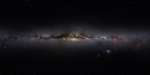 A Journey Through the Night Sky
20.05.2011
Majestic nebulae and stars of our Milky Way Galaxy stretch across this panoramic image of the entire night sky. At full resolution, the 5 gigapixel mosaic was stitched together from over 37,000 images...
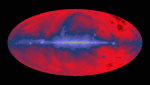 The Radio Sky: Tuned to 408MHz
3.04.1999
Tune your radio telescope to 408MHz (408 million cycles per second) and check out the Radio Sky! You should find that frequency on your dial somewhere between US broadcast television channels 13 and 14.
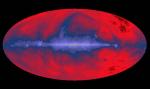 The Radio Sky: Tuned to 408MHz
20.10.2001
Tune your radio telescope to 408MHz (408 million cycles per second) and check out the Radio Sky! You should find that frequency on your dial somewhere between US broadcast television channels 13 and 14.
|
January February March April May June July August |
||||||||||||||||||||||||||||||||||||||||||||||||||||||||