
|
You entered: composite image
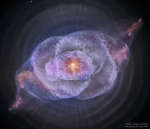 The Cats Eye Nebula in Optical and X-ray
7.11.2021
To some it looks like a cat's eye. To others, perhaps like a giant cosmic conch shell. It is actually one of brightest and most highly detailed planetary nebula known, composed of gas expelled in the brief yet glorious phase near the end of life of a Sun-like star.
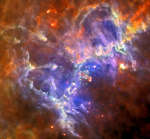 Inside the Eagle Nebula
3.02.2012
In 1995, a now famous picture from the Hubble Space Telescope featured Pillars of Creation, star forming columns of cold gas and dust light-years long inside M16, the Eagle Nebula. This remarkable false-color composite image revisits the nearby stellar nursery with image data from the orbiting Herschel Space Observatory and XMM-Newton telescopes.
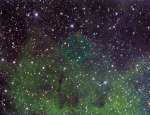 A Bubble in Cygnus
13.11.2008
Adrift in the rich star fields of the constellation Cygnus, this lovely, symmetric bubble nebula was only recently recognized and may not yet appear in astronomical catalogs. In fact, amateur astronomer Dave Jurasevich identified...
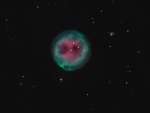 M97: The Owl Nebula
15.05.2009
The Owl Nebula is perched in the sky about 2,600 light-years away toward the bottom of the Big Dipper's bowl. Also cataloged as M97, the 97th object in Messier's well-known list, its round shape along with the placement of two large, dark "eyes" do suggest the face of a staring owl.
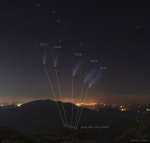 The Shifting Tails of Comet NEOWISE
12.08.2020
Keep your eye on the ion tail of Comet NEOWISE. A tale of this tail is the trail of the Earth. As with all comets, the blue ion tail always points away from the Sun. But as Comet C/2020 F3 (NEOWISE) rounded our Sun, its ion tail pointed in slightly different directions.
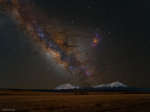 Milky Way Over the Spanish Peaks
24.05.2016
That's not lightning, and it did not strike between those mountains. The diagonal band is actually the central band of our Milky Way Galaxy, while the twin peaks are actually called the Spanish Peaks -- but located in Colorado, USA.
 Earth at Night
7.12.2012
This remarkably complete view of Earth at night is a composite of cloud-free, nighttime images. The images were collected during April and October 2012 by the Suomi-NPP satellite from polar orbit about 824 kilometers (512 miles) above the surface using its Visible Infrared Imaging Radiometer Suite (VIIRS).
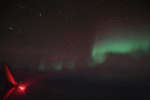 Quadrantid Meteors and Aurora from the Air
7.01.2008
Where do meteor showers originate? To help answer this question, astronomers studied in some detail the Quadrantid meteor shower that occurred over this past weekend. In particular, astronomers with specialized cameras flew as part...
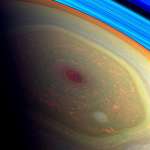 Saturn s Swirling Cloudscape
6.08.2014
Acquiring its first sunlit views of far northern Saturn in late 2012, the Cassini spacecraft's wide-angle camera recorded this stunning, false-color image of the ringed planet's north pole. The composite of near-infrared image data results in red hues for low clouds and green for high ones, giving the Saturnian cloudscape a vivid appearance.
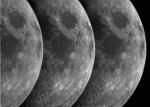 Cassini Images The Moon
10.09.1999
On August 18, the Cassini spacecraft flew by the Earth and Moon, then continued on its way to the outer solar system. Near its closest approach to the Moon, a distance of about 377,000 kilometers, controllers tested Cassini's imaging systems on this most familiar celestial body.
|
January February March April May June July August September |
|||||||||||||||||||||||||||||||||||||||||||||||||