
|
You entered: X-ray source
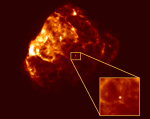 Supernova Remnant and Neutron Star
14.11.1996
A massive star ends life as a supernova, blasting its outer layers back to interstellar space. The spectacular death explosion is initiated by the collapse of what has become an impossibly dense stellar core. However, this core is not necessarily destroyed.
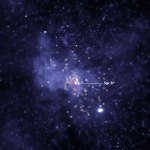 A Plurality of Singularities at the Galactic Center
12.05.2018
A recent informal poll found that astronomers don't yet have a good collective noun for a group of black holes, but they need one. The red circles in this Chandra Observatory X-ray image identify a group of a dozen black holes that are members of binary star systems.
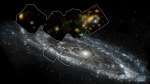 High Energy Andromeda
7.01.2016
A mere 2.5 million light-years away, the Andromeda Galaxy, also known as M31, really is just next door as large galaxies go. In this (inset) scan, image data from NASA's Nuclear Spectrosopic Telescope...
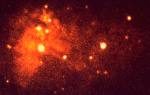 LMC X-1: A Black Hole Candidate
30.12.1995
The strongest source of X-rays in the Large Magellanic Cloud originates from an unusually energetic binary star system. This strong source, dubbed LMC X-1, is thought to be a normal and compact star orbiting each other. Gas stripped of the normal star falls onto the compact star, heats up, and emits X-rays.
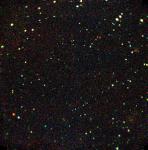 Chandra Deep Field
28.03.2001
Officially the Chandra Deep Field - South, this picture represents the deepest ever x-ray image of the Universe. One million seconds of accumulated exposure time with the orbiting Chandra X-ray Observatory went in to its making.
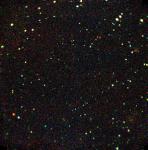 Chandra Deep Field
12.10.2002
Officially the Chandra Deep Field - South, this picture represents the deepest ever x-ray image of the Universe. One million seconds of accumulated exposure time with the orbiting Chandra X-ray Observatory went in to its making.
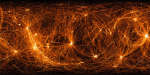 NICER at Night
1.06.2019
A payload on board the International Space Station, the Neutron star Interior Composition Explorer (NICER) twists and turns to track cosmic sources of X-rays as the station orbits planet Earth every 93 minutes. During orbit nighttime, its X-ray detectors remain on.
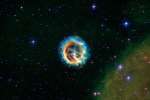 Supernova Remnant E0102 72
5.09.2009
The expanding debris cloud from the explosion of a massive star is captured in this multiwavelength composite, combining x-ray and optical images from the Chandra and Hubble telescopes. Identified as E0102-72, the supernova remnant lies about 190,000 light-years away in our neighboring galaxy, the Small Magellanic Cloud.
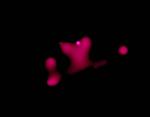 The Heart in NGC 346
14.02.2003
Yes, it's Valentine's Day (!) and looking toward star cluster NGC 346 in our neighboring galaxy the Small Magellanic Cloud, astronomers have noted this heart-shaped cloud of hot, x-ray emitting gas in the cluster's central region.
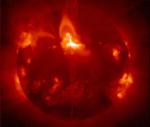 Active Regions, CMEs, and X Class Flares
8.06.2000
Space Weather forcasters are predicting major storm conditions over the next few days as the active Sun has produced at least three strong flares and a large coronal mass ejection (CME) since Tuesday, June 6th.
|
January February March April May June July August September October |
|||||||||||||||||||||||||||||||||||||||||||||||||