
|
You entered: Ursa Major
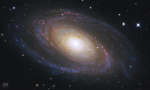 Messier 81
27.03.2025
One of the brightest galaxies in planet Earth's sky is similar in size to our Milky Way Galaxy: big, beautiful Messier 81. Also known as NGC 3031 or Bode's galaxy for its 18th century discoverer, this grand spiral can be found toward the northern constellation of Ursa Major, the Great Bear.
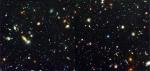 The Deep Field
9.02.1997
Galaxies like colorful pieces of candy fill the Hubble Deep Field - humanity's most distant yet optical view of the Universe. The dimmest, some as faint as 30th magnitude (about four billion times fainter...
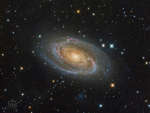 Messier 81
17.04.2019
One of the brightest galaxies in planet Earth's sky is similar in size to our Milky Way Galaxy: big, beautiful Messier 81. Also known as NGC 3031 or Bode's galaxy for its 18th century discoverer, this grand spiral can be found toward the northern constellation of Ursa Major, the Great Bear.
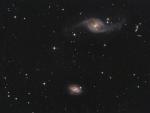 Galaxies in View
7.06.2005
Galaxies abound in this cosmic scene, a well chosen telescopic view toward the northern constellation of Ursa Major. Most noticeable are the striking pair of spiral galaxies - NGC 3718 (above, right) and NGC 3729 (below center) - a mere 52 million light-years distant.
 The Deep Field
24.01.1996
The image above is part of the Hubble Deep Field and represents humanity's most distant yet optical view of the Universe. Galaxies like colorful pieces of candy fill the field, some as faint as 30th magnitude (about four billion times fainter than stars visible to the unaided eye).
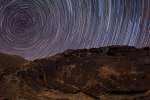 Teimareh Petroglyphs and Star Trails
12.07.2012
Engraved in rock, these ancient petroglyphs are abundant in the Teimareh valley, located in the Zagros Mountains of central Iran. They likely tell a tale of hunters and animals found in the middle eastern valley 6,000 years ago or more, etched by artists in a prehistoric age.
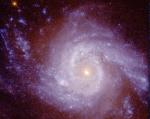 Spiral Galaxy NGC 3310 in Ultraviolet
17.01.2001
Why is NGC 3310 bursting with young stars? The brightest of these new stars are so hot that they light up this spiral galaxy not only in blue light, but in light so blue humans can't see it: ultraviolet. The Hubble Space Telescope took the above photograph in different bands of ultraviolet light.
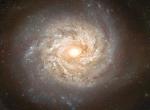 Spiral Galaxy NGC 3982 Before Supernova
3.11.2003
What do stars look like just before they explode? To find out, astronomers are taking detailed images of nearby galaxies now, before any supernova is visible. Hopefully, a star in one of the hundreds of high resolution galaxy images will explode in the coming years.
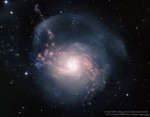 NGC 3310: A Starburst Spiral Galaxy
1.03.2016
The party is still going on in spiral galaxy NGC 3310. Roughly 100 million years ago, NGC 3310 likely collided with a smaller galaxy causing the large spiral galaxy to light up with a tremendous burst of star formation.
 M106 in Canes Venatici
30.07.2005
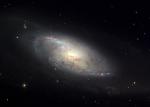
Close to the Great Bear (Ursa Major) and surrounded by the stars of the Hunting Dogs (Canes Venatici), this celestial nebula was discovered in 1781 by the metric French astronomer Pierre Mechain. Later, it was added to the catalog of his friend and colleague Charles Messier as M106.
|
January February March April May June July August September |
|||||||||||||||||||||||||||||||||||||||||||||||||