
|
You entered: Sun
 A Solstice Sun Tattoo
20.12.2025
The word solstice is from the Latin for Sun and to pause or stand still. And in the days surrounding a solstice the Sun's annual north-south drift in planet Earth's sky does slow down, pause, and then reverse direction.
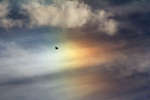 Bird Sun Dog
27.05.2013
Have you ever seen a little rainbow off to the side of the Sun? Rare but rewarding to see, such spectacles are known as sundogs, mock suns or parhelia. Sundogs are just sunlight refracting through hexagonal falling ice crystals in the Earth's atmosphere.
 Across the Sun
30.04.2015
A long solar filament stretches across the relatively calm surface of the Sun in this telescopic snap shot from April 27. The negative or inverted narrowband image was made in the light of ionized hydrogen atoms.
 Apollo 11: Catching Some Sun
29.07.2023
Bright sunlight glints as long dark shadows mark this image of the surface of the Moon. It was taken fifty-four years ago, July 20, 1969, by Apollo 11 astronaut Neil Armstrong, the first to walk on the lunar surface. Pictured is the mission's lunar module, the Eagle, and spacesuited lunar module pilot Buzz Aldrin.
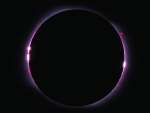 At the Sun s Edge
7.08.2008
A train trip on the Trans-Siberian railway to Novosibirsk resulted in this stunning view along the edge of the Sun recorded during the August 1st total solar eclipse. The picture is a composite...
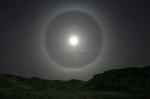 A Sun Halo over Utah
11.04.2006
Have you ever seen a halo around the Sun? This fairly common sight occurs when high thin clouds containing millions of tiny ice crystals cover much of the sky. Each ice crystal acts like a miniature lens.
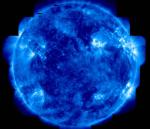 Autumn and the Active Sun
23.09.1998
As the Sun heads South, crossing the celestial equator today at 1:37 a.m. Eastern Time, Autumn begins for Earth's Northern Hemisphere. This Autumnal Equinox finds an increasingly active Sun steadily approaching a solar cycle maximum expected around the year 2003.
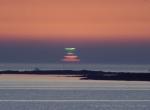 A Green Flash from the Sun
21.03.2004
Many think it is just a myth. Others think it is true but its cause isn't known. Adventurers pride themselves on having seen it. It's a green flash from the Sun. The truth is the green flash does exist and its cause is well understood.
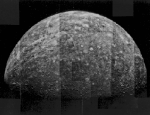 Mercury: Closest Planet to the Sun
14.08.1995
This picture was compiled from images taken by the NASA spacecraft Mariner 10 which flew by the planet three times in 1974. Mercury is the closest planet to the Sun, the second hottest planet (Venus gets hotter), and the second smallest planet (Pluto is smaller).
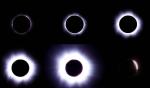 Light From The Dark Sun
19.08.1999
Only in the fleeting darkness of a total solar eclipse is the light of the solar corona easily visible from Earth. Normally overwhelmed by the bright solar disk, the expansive corona, the sun's outer atmosphere, is an alluring sight.
|
January February March April May June July August September |
|||||||||||||||||||||||||||||||||||||||||||||||||